Full StackDashboardBusiness Platform
WeTrainEducation & Tech
A unified education, digital services, and enterprise solutions platform for business growth
Step 01: Overview
WeTrainEducation & Tech is a full-scale digital services platform combining professional training, enterprise software solutions, marketing services, customer management, payments, order processing, certifications, project inquiries, and admin operations within one connected ecosystem.
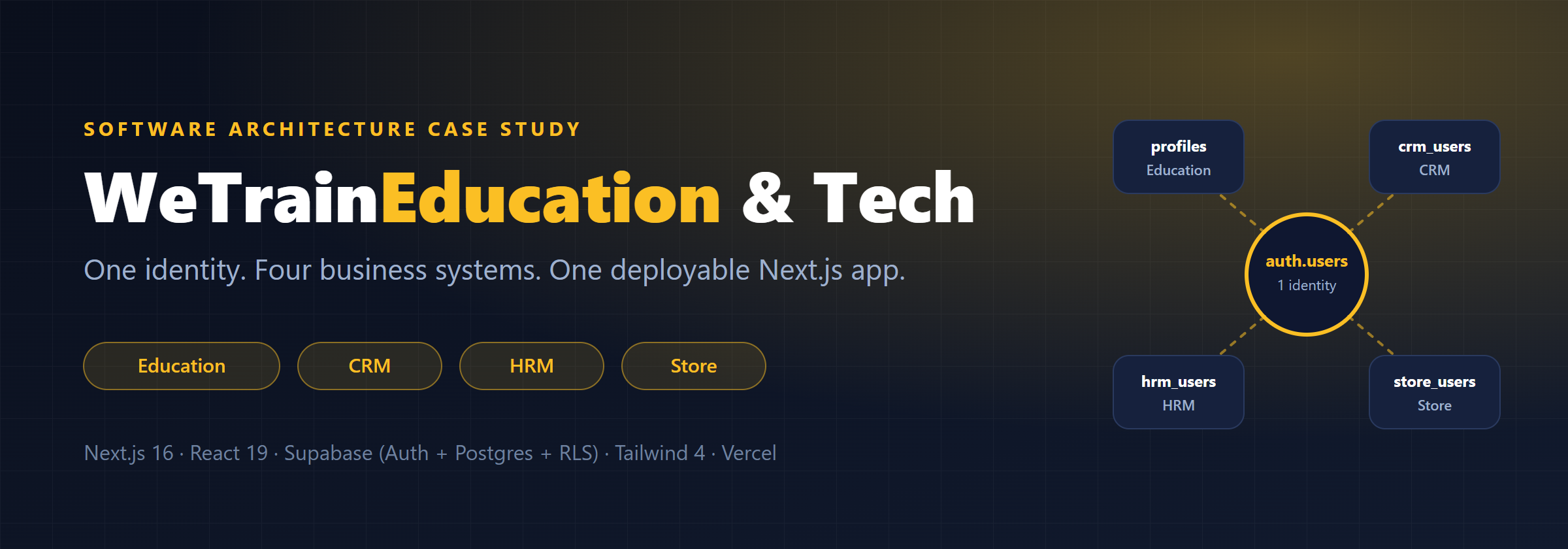
One Supabase identity, four business systems, one deployable Next.js application. A public marketing site plus three internal products (Education, CRM, HRM) and an internal Store, built so that each business area can change without putting the others at risk.
Area Details Role Architecture, full-stack engineering, database design, DevOps Stack Next.js 16 (App Router, proxy.ts), React 19, TypeScript, Supabase (Auth, Postgres, RLS, Storage)UI Tailwind CSS 4, shadcn/ui on Radix, Recharts, TanStack Table, next-intl (EN/BN) Integrations SMS Pay BD (payments + webhooks), SMTP (Nodemailer), Vercel Cron Delivery Vercel, GitHub Actions CI, Supabase CLI migrations Status In production use; actively evolving Step 02: 1. The problem
WeTrainEducation & Tech sells training courses, software and marketing services, and runs an internal organisation around that. In practice that means four very different groups of people use the same company's systems:
Persona What they need Shape of their data Visitors & students Discover services, request proposals, pay, track subscriptions Unbounded growth, mostly self-service Sales team Leads, a deal pipeline, contracts, recurring billing Hundreds of records, ownership-based Staff & interns Weekly reporting, scoring, recruitment, attendance Tens of people, hierarchy-based Office operations A tiny internal shop with stock, invoices and per-employee ledgers Money-like data that must stay consistent Off-the-shelf tools covered each need badly and none of them shared an identity. The brief was to replace the patchwork with one coherent platform, without building four separate apps that would each need their own login, deploy and on-call.
Constraints that shaped every decision
- Small team, one deployable. Operational overhead had to stay close to zero: no service mesh, no per-module infrastructure.
- Real money and real people's data. Payments, payroll-adjacent scoring and applicant CVs mean a wrong permission is an incident, not a bug.
- Live data. Schema changes must be backward compatible and rehearsed on a test database first.
- Bangladesh context. Local payment gateway (SMS Pay BD),
Asia/Dhakatime for all scheduled work, Bangla as a first-class language on the public site. - AI-assisted development. The repo is worked on with coding agents, so the architecture needs to be legible: explicit boundaries, written rules, and fast feedback.
Step 03: 2. The solution at a glance
A modular monolith: one Next.js application with hard internal boundaries, one Supabase project as the single source of identity and data, and a layered authorization model that fails closed.
Metric (measured on this repo) Value TypeScript / TSX source files ~590 (~100k lines) Pages / route handlers / layouts 119 / 83 / 13 Server-action modules ( "use server")34 Route-level loading skeletons ( loading.tsx)26 SQL migrations 104, all applying cleanly from an empty database Tables / RLS policy statements 90+ / ~400 Scheduled jobs (Vercel Cron) 6 Automated tests ( node:test)88 across 6 suites, all passing Step 04: 3. System architecture
3.1 Context and containers
Diagram 3.2 Module ownership
Every route belongs to exactly one module. Shared code is deliberately small, and a module never imports another module's business logic.
Module Route prefix Owns (tables) Roles Landing /(landing)services,certifications,featured_projects,client_stories,proposals(insert only)anonymous Education /dashboard/customer,/dashboard/adminprofiles,orders,payments(customer-facing views of CRM billing and documents)customer,adminCRM /dashboard/crmcrm_users,crm_leads,deals,proposals,documents,billing_schedules,invoices,payment_links,crm_contact_logsADMIN,MARKETERHRM /dashboard/hrmhrm_users,hrm_weeks,hrm_task_*,hrm_intern_*SUPER_ADMIN,ADMIN,EMPLOYEEStore /dashboard/storestore_users,store_products,store_stock_movements,store_invoices,store_account_entriesUSER,ADMIN+ permissions3.3 Dependency direction
Diagram The arrows only ever point down into the shared kernel. CRM links to a customer by
profile_id, never by importing Education code. This is what lets an engineer, or an AI agent, work on HRM payroll-adjacent logic with confidence that Education checkout cannot break.Step 05: 4. Architecture decisions
Each decision below is recorded as a short ADR: context, decision, alternatives and the cost we accepted. The longer-form originals live in
docs/.ADR-001: Modular monolith, not microservices or a Turborepo
- Context: Four systems with different owners and release pressure, but a team small enough that distributed systems would dominate the work.
- Decision: One Next.js app. Boundaries are enforced by route prefixes, per-module folders (
_actions,_components,_lib,_constants) and written rules, not by network hops. - Rejected: Microservices (operational cost, cross-service auth); Turborepo with one app per module (four deploys, duplicated shell and auth, no real isolation gain at this size).
- Cost: Boundaries are social plus lint-level, not physical. Mitigated by the "Module boundaries" skill file and by keeping shared code minimal.
- Exit path: Each module already has its own route group, tables and guards, so it can be lifted into its own app if scale ever demands it.
ADR-002: One identity (
auth.users), separate domain profiles per moduleThis is the load-bearing decision of the whole system.
- Context: The same person can be a student, a sales marketer, an employee and a store user at the same time.
- Decision:
auth.usersis the only identity. Each module owns a table whose primary key is the auth user id:profiles,crm_users,hrm_users,store_users. Having a row = having access to that module. - Rejected: (A) one fat
userstable with ~20 mostly-null columns and a shared RLS policy; (B) separate auth per system (no SSO, email collisions, three bills). - Why it works: Roles live in separate namespaces (
MARKETERnever collides withEMPLOYEE), each table gets its own indexes and RLS, and a bug in one module's schema cannot corrupt another's. - Cost: Email is denormalised in several places, so a database trigger keeps it in sync; role resolution touches several tables (mitigated in ADR-004).
Diagram Identity: every module table shares the primary key of
auth.users.Diagram Education and CRM: customer money flow and the sales pipeline.
Diagram HRM and Store: weekly reporting, recruitment, and the ledger-backed shop.
ADR-003: Priority-based routing across modules
A user with several memberships needs a deterministic home. The rule is Education > CRM > HRM > Store, with an explicit module switcher (see the product tour) for everything else.
Diagram The same priority table exists in two places on purpose:
proxy.tsfor fast redirects andapp/dashboard/page.tsxfor the server-rendered entry. The written rule inAGENTS.mdanddocs/CRITICAL_SYSTEMS.mdkeeps them aligned; a shared, tested routing function is on the roadmap.ADR-004: One role resolver,
getCurrentUserWithRoles()- Context: Layouts, guards, the sidebar and the module switcher all need to know "what can this user do?". Ad-hoc lookups scatter authorization logic and multiply database round-trips.
- Decision: A single server function returns a typed
UserWithRoles(education role, CRM role, HRM role, Store role + granular Store permissions, derived capability flags). Guards (requireCrmAdmin(),requireHrmSuperAdmin(),requireStorePermission(...)) are thin wrappers over it. - Detail: Missing optional tables (a module not yet rolled out) degrade to "no access" instead of crashing; a deactivated HRM user resolves to no HRM access (
activeHrmRole). - Cost: It is a hot path: five indexed point lookups per call, currently issued sequentially. Accepted for correctness; running them concurrently and memoising per request are on the roadmap.
ts// app/utils/auth/require.ts (excerpt): every guard is the same two steps export async function requireCrmAdmin(): Promise<UserWithRoles> { const roles = await requireAuth(); // 1. signed in + has any module if (!isCrmAdmin(roles)) redirect("/unauthorized"); // 2. has this specific capability return roles; }ADR-005: Authorization is layered, and the proxy is deliberately not the security boundary
Next.js 16 renamed
middlewaretoproxyand its own documentation steers authors away from doing heavy authorization there. We follow that guidance:proxy.tsdoes only what must happen on every request: refresh the Supabase cookie, redirect anonymous users, send logged-in users to the right app home.- Real enforcement happens in server layouts and server actions (
requireXAccess()), and finally in Postgres RLS. - The proxy fails closed: if the role lookup throws on a protected route the user is sent to
/login, never waved through. Public routes are never blocked by an infrastructure blip.
See Section 6 for the full picture.
ADR-006: Server Actions for mutations, Route Handlers only for machines
- Decision: Human-driven writes go through Server Actions colocated under
app/**/_actions/. Route Handlers are reserved for things a browser form cannot do: webhooks, cron, signed downloads, uploads. - Why: Actions give end-to-end types, no hand-written API surface to secure, and
revalidatePathfor cache coherence. - Rule: A
"use server"file may only export async functions, so constants and enums live in sibling_constants/modules.
ADR-007: Three Supabase client flavours, with the privileged one opt-in
Client Key Respects RLS Used for createClient()(server, cookies)publishable / anon Yes Default for reads and most writes createClient()(browser)publishable / anon Yes Auth UI and light client interactions createAdminClient()secret / service role No Auth admin, cron, webhooks, selected writes behind a guard The admin client is
server-only, documented as dangerous at its definition, and every call site is expected to sit behind arequireXAdmin()guard. Env access is centralised inenv.ts, which also accepts both the new (publishable/secret) and legacy (anon/service_role) Supabase key names so the app survives the platform's key migration.ADR-008: Database-first safety (RLS, forward-only migrations, test then live)
- RLS on, always. Every new table is evaluated for RLS immediately; policies are tested for the intended role and one unintended role.
- Forward-only, additive migrations. Applied migration files are never edited. Because production holds live data, changes are backward compatible.
- Two-step rollout.
npm run migrate:test, verify behaviour and RLS, thennpm run migrate:live. The migration script knows both project refs and refuses to guess. - Narrow public writes. The public proposal form inserts with the anon key under a policy that only permits a fresh
NEWrow and forbids setting any lifecycle field, so a visitor can create but never read, update or escalate:
sqlCREATE POLICY "proposals_public_insert" ON public.proposals FOR INSERT TO anon, authenticated WITH CHECK ( status = 'NEW' AND lead_id IS NULL AND reviewed_by IS NULL AND reviewed_at IS NULL AND internal_note IS NULL );ADR-009: Idempotent, secret-protected scheduled work
Every cron endpoint (
/api/hrm/cron/*,/api/billing/cron/run) is protected by a shared secret (X-CRON-SECRETor Vercel's bearer token) and is safe to run twice. Weeks are created atomically and de-duplicated; invoices are de-duplicated on(schedule_id, due_on); reminders and warnings are recorded so a retried run sends nothing new. See Section 9.ADR-010: Payments through a signed, verified webhook
Order fulfilment is driven only by an HMAC-SHA256-verified webhook from SMS Pay, compared with
crypto.timingSafeEqualover the raw request body. The browser redirect is never trusted as proof of payment, and the/api/checkout/confirmroute is a read-only status check that exists purely so the checkout page can show progress. The subscription system adds a second, separate webhook endpoint (mappinginv_<id>back to an invoice through a unique payment-link intent id) so the original checkout path stayed untouched while billing was added.ADR-011: Subscriptions as scheduled payment links, not card-on-file
The local gateway has no auto-debit. Rather than fake it, billing is a daily idempotent cycle that materialises invoices, issues a 14-day payment link, emails it, reminds at +3 and +7 days, and marks overdue. It is simple, auditable, and does not require storing payment credentials.
ADR-012: Cookie-based i18n with no URL segment
Locale (
bn/en) is stored in aNEXT_LOCALEcookie and resolved server-side bynext-intl. English is the default; Bangla is one click away. This avoided restructuring every route under/[locale]and keeps auth callback URLs stable. Only the public site is translated today; dashboards remain English by design (the staff working language).ADR-013: Docs as part of the architecture
AGENTS.mdis the single source of truth for contributors and AI agents, with a required reading order (CRITICAL_SYSTEMS→ skills → module docs → stack docs → code) and an explicit list of high-risk areas (proxy.ts,app/utils/auth/*,app/utils/supabase/*,app/auth/*, cron routes, payment flows).docs/is kept as a durable reference set, not a task log.Decision summary
# Decision Primary benefit Accepted cost 001 Modular monolith One deploy, low ops Soft boundaries 002 One identity + per-module profile tables SSO and isolation Denormalised email, multi-table lookup 003 Education > CRM > HRM > Store routing Deterministic landing Rule duplicated in two places 004 Single role resolver One place to reason about access Hot path, several queries 005 Proxy as coarse gate only Framework-aligned, fails closed Must remember layout guards 006 Actions for people, routes for machines Typed, small attack surface Convention to maintain 007 Privileged client is opt-in Least privilege by default Discipline at call sites 008 RLS + forward-only migrations Safe on live data Slower schema change 009 Idempotent secret-protected cron Safe retries Extra bookkeeping columns 010 HMAC-verified webhook Tamper-proof payment state Webhook setup per environment 011 Scheduled payment links Works with the local gateway Not fully automatic 012 Cookie-based locale Stable URLs, small change Not shareable by URL 013 Docs and agent rules as architecture Safe AI-assisted changes Docs must be curated Step 06: 5. Identity and access model
5.1 The role resolver
Diagram The returned object is deliberately flat and boring:
tsinterface UserWithRoles { userId: string; email: string; profileRole: "customer" | "admin" | null; crmRole: "ADMIN" | "MARKETER" | null; hrmRole: "SUPER_ADMIN" | "ADMIN" | "EMPLOYEE" | null; storeRole: "USER" | "ADMIN" | null; hasEducationAccess: boolean; hasCrmAccess: boolean; hasHrmAccess: boolean; hasStoreAccess: boolean; storePermissions: StorePermission[]; // owner_purchase_manage, balance_add, ... storeCapabilities: StoreCapabilities; // role AND permission, pre-computed canAccessCrmAdmin: boolean; canActAsCrmMarketer: boolean; }5.2 Role matrix
Capability Customer CRM Marketer CRM Admin HRM Employee HRM Admin HRM Super Store User Store Admin* Buy courses, view own payments ✅ - - - - - - - Work leads and deals - ✅ ✅ - - - - - Manage CRM users, import, delete - - ✅ - - - - - Submit weekly task reports - - - ✅ ✅ ✅ - - Mark weekly reports - - - - ✅ ✅ - - Manage departments, recruitment - - - - - ✅ - - Buy from the office store - - - - - - ✅ ✅ Manage stock, products, balances - - - - - - - ✅* * Store admins hold granular permissions (
stock_manage,product_manage,invoice_manage,balance_add,owner_purchase_manage,permissions_manage). BeingADMINis necessary but not sufficient.Step 07: 6. Request lifecycle and defence in depth
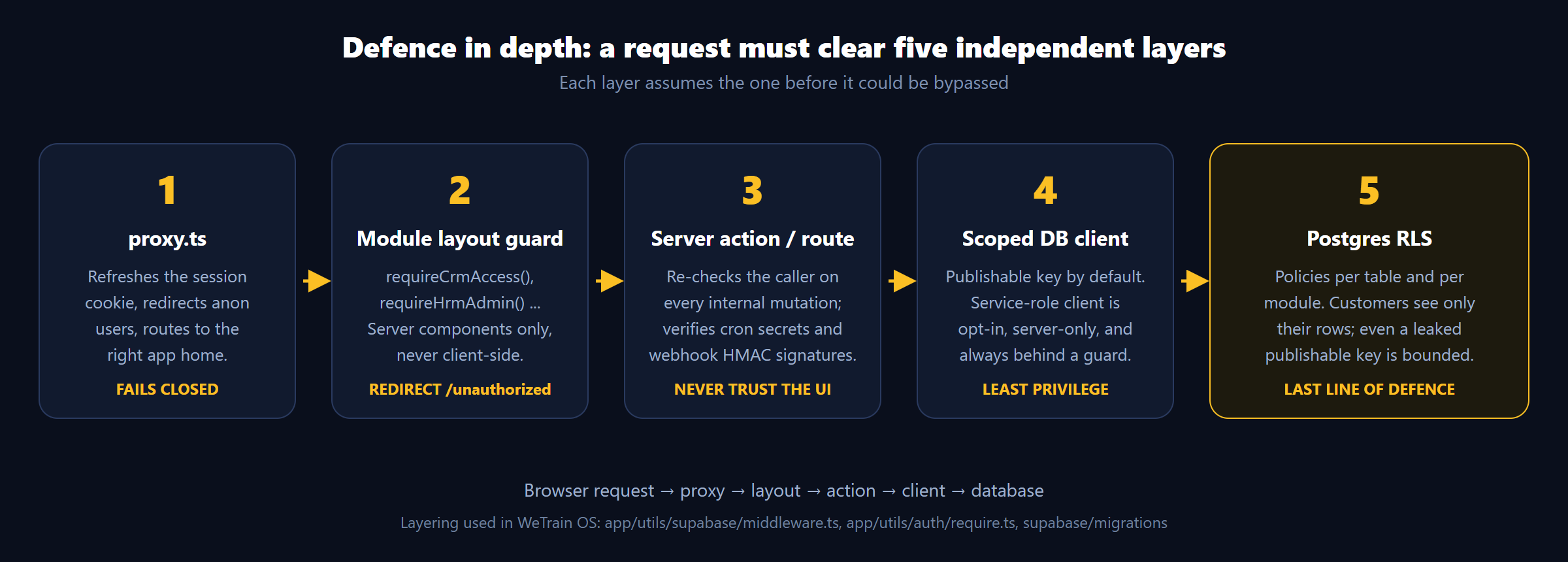
6.1 The path of a protected request
Diagram 6.2 What each layer is responsible for
Layer File(s) Responsibility Fails to 1. Proxy proxy.ts,app/utils/supabase/middleware.tsSession refresh, anon redirect, app-home routing /login2. Layout guard app/dashboard/*/layout.tsx,app/utils/auth/require.tsModule and sub-module access ( requireHrmSuperAdmin, ...)/unauthorized3. Action / route app/**/_actions/*,app/api/**/route.tsRe-check the caller, validate input, verify cron secrets and webhook signatures 401 / 403 / error result 4. Scoped client app/utils/supabase/{server,admin}.tsLeast privilege: publishable key by default, secret key opt-in RLS denies 5. RLS supabase/migrations/*Row-level truth, independent of the app zero rows 6.3 A worked example: signed document downloads
CRM contracts live in a private Storage bucket. The download route resolves the caller, loads the document with the privileged client, then applies application-level policy that mirrors RLS: any CRM user, or the specific customer the current version was explicitly shared with. It returns a 5-minute signed URL, never a public link.
ts// app/api/documents/[id]/download/route.ts (excerpt) const isCrm = roles.hasCrmAccess; const isSharedCustomer = doc.customer_profile_id === roles.userId && doc.shared_at !== null && doc.is_current; if (!isCrm && !isSharedCustomer) { return NextResponse.json({ error: "Forbidden" }, { status: 403 }); } const { data: signed } = await supabase.storage .from(doc.storage_bucket || "crm-documents") .createSignedUrl(doc.storage_path, 60 * 5, { download: doc.file_name });Step 08: 7. Data architecture
7.1 Principles
Principle How it shows up Identity is external to domains Every *_usersPK is an FK toauth.users(id); deleting an auth user cascadesPrefer enums to free text deal_stage,invoice_status,proposal_status,payment_link_status,document_kindAppend-only history for audits deal_eventstimeline, intern application events, email delivery logsVersioned documents group_id + version + is_currentinstead of overwriting contractsConstraints encode business rules e.g. an HRM week key must equal its Friday date; unique (program, email)per applicantMoney-like data is ledger-derived Store balances are computed from store_account_entries, never stored as a mutable number7.2 The CRM sales pipeline
Diagram Every transition writes a row to
deal_events(STAGE_CHANGED,NOTE,VALUE_CHANGED,OWNER_CHANGED,WON,LOST,REOPENED), so the timeline on the deal page is a read of an immutable log rather than a derived guess.7.3 The internship pipeline
Applicants have no direct table access. The public form writes through a server action using the service role, protected by a unique
(program, email)index and a best-effort rate limiter. Applicants follow progress with an unguessable tracking token, and internal stages that should stay private (waitlist, no-show, declined offer) are collapsed before they reach the applicant-facing view.Diagram ts// lib/internships/status.ts (excerpt): 13 internal states become 7 applicant-facing stages export function toApplicantStage(status: string): ApplicantStage { switch (status) { case "SUBMITTED": return "received"; case "UNDER_REVIEW": case "WAITLISTED": return "review"; // a waitlist is never revealed case "INTERVIEW_SCHEDULED": case "INTERVIEWED": return "interview"; case "SELECTED": case "OFFER_ACCEPTED": return "selected"; /* ... */ default: return "closed"; // rejected, declined, no-show, ... } }7.4 Database change management
Diagram All 104 migrations apply cleanly on a fresh local Supabase stack (
supabase start), which is also how the screenshots in this document were produced.Step 09: 8. Module deep dives
8.1 Landing: public conversion
- Server-rendered marketing pages (home, services, courses, software, marketing, pricing, internships, certificates, employees, legal pages).
- A 4-step proposal wizard (React Hook Form + Zod) that inserts a proposal with the anon key under the narrow RLS policy above.
- Internship application with CV upload, applicant tracking page (
/internships/track/[token]), offer accept/decline (/internships/offer/[token]) and public certificate verification (/verify/intern/[code]). - English by default with a Bangla switch; a floating chat/WhatsApp entry point; dark, yellow-branded design.
8.2 Education: customers and payments
- Customers browse packages, buy through SMS Pay, and see payments, subscriptions and the documents shared with them.
- Checkout creates a payment intent, then waits for the verified webhook (
FINAL_STATUSES:completed,rejected,expired) before moving the order. - The education admin dashboard summarises customers, revenue, orders and pending payments.
8.3 CRM: from lead to recurring revenue
Diagram Design notes worth calling out:
- Leads are written through the service-role client behind CRM guards because the lead RLS model is built around that write path; deals use the authenticated client, so RLS applies. The difference is intentional and documented per action file.
- Contracts are not a separate table: a contract is a
documentwith akindand nullablecontract_status,effective_date,expires_date,counterparty. Fewer joins, one upload path, one RLS policy. - Nothing is customer-visible until a CRM user shares it.
8.4 HRM: performance, recruitment and attendance
Three sub-systems share the module:
- Weekly reporting and scoring. Employees submit weekly task reports; admins mark them with a single 0–100 score; a Friday cron closes the week and computes results; a super admin generates the monthly average and tiers (
BONUS,APPRECIATION,IMPROVEMENT,FINE). All time logic is pinned toAsia/Dhaka, and week keys are validated to be the Friday date by a databaseCHECKconstraint. - Internship recruitment. Programs, positions, applications, scored reviews, scheduled interviews (with
.icsinvites and reminder emails), offers with expiry, and onboarding. - Intern attendance and certification. Mandatory/optional shifts, grace and minimum-presence rules, no-show handling, attendance warnings, completion, certificate issuance and revocation.
8.5 Store: a tiny ledger-backed shop
- Employees buy snacks and stationery on account; balances are derived from a ledger, not stored.
- Admins manage products, stock movements, month closures and owner purchases, gated by granular permissions.
- Reports export to CSV and PDF (
jspdf,xlsx). - Independence is deliberate:
store_usersdoes not depend on HRM, even though admin delegation echoes the company hierarchy.
Step 10: 9. Background jobs and integrations
9.1 Scheduled jobs
All schedules are declared in
vercel.json. Times are UTC; the business runs onAsia/Dhaka(UTC+6).Route UTC Dhaka Purpose /api/hrm/cron/create-weekly-pending-reportsFri 03:00 Fri 09:00 Atomically create the week and one pending report per active employee /api/hrm/cron/remind-weekly-reportFri 03:05 Fri 09:05 Remind employees whose report is still pending /api/hrm/cron/compute-last-fridayFri 17:30 Fri 23:30 Store score-only results and close the week /api/hrm/cron/intern-interview-remindersDaily 03:00 Daily 09:00 Email reminders for interviews in the next 36 hours /api/hrm/cron/intern-dailyDaily 13:00 Daily 19:00 Absences, auto check-out, attendance warnings, expiry and cleanup /api/billing/cron/runDaily 02:00 Daily 08:00 Materialise invoices, issue links, mark overdue, send reminders 9.2 The billing cycle
Diagram 9.3 Failure containment
Failure Behaviour SMTP is down The database action still commits; the delivery is logged as FAILEDand can be retried from the admin UICron fires twice No duplicate weeks, invoices, reports, reminders or warnings Webhook replayed or forged Signature check rejects forgeries; processing is keyed on the intent id Role lookup fails in the proxy Protected routes redirect to /login; public routes are unaffectedA module's table is missing (rollout) Role resolver treats it as "no access" rather than throwing Step 11: 10. Frontend architecture
Concern Approach Rendering Server Components by default; Client Components only for interaction (forms, charts, tables) Data loading Fetch on the server, stream with 26 route-level loading.tsxskeletons; no client data-fetching library neededForms React Hook Form + Zod resolvers; validation schemas shared in lib/validationsDesign system shadcn/ui on Radix primitives (30 components in components/ui), Tailwind CSS 4 with CSS variablesTheming Yellow brand, dark-first dashboards with light-theme support; a test fails if hard-coded light colours creep back in Tables and charts TanStack Table, Recharts Navigation A shared DashboardShellwith per-module sidebars, breadcrumbs, and a module switcher for multi-role usersResponsive Mobile-first; dashboards collapse to a bottom navigation on phones i18n next-intl, cookie-driven, English default, Bangla available on the public sitePWA Service-worker registration for installable behaviour Diagram Step 12: 11. Quality engineering
11.1 Tests
Tests use the Node built-in runner (
node --test) withtsx, so there is no test framework to maintain. The suites target domain logic (the part that is expensive to get wrong) rather than rendering.Suite Tests What it protects test:hrm56 KPI flow, cron auth, HRM access/deactivation, recruitment, offers, emails, intern attendance and completion test:store15 Ledger math, reporting, store domain rules test:crm6 CRM domain rules test:edu5 Service pricing test:landing5 Public form validation test:ui1 Theme-contrast guard (no hard-coded light colours in dark surfaces) Total 88 All passing bashnpm run test:all11.2 Static checks and CI
Prettier (
format:check), ESLint 9 with the Next config, TypeScript vianext build, and unit tests run on every push and pull request.11.3 Seeding and environments
scripts/seed-public.mjs,seed-crm.mjs,seed-hrm.mjscreate test identities, leads, services, projects and payments;db:cleanresets.- A development environment ribbon is rendered in non-production so nobody mistakes a test deployment for the real thing.
verify:intern-dbchecks that the internship migrations are present on the target database.
Step 13: 12. Delivery pipeline
Diagram Concern Choice Hosting Vercel (serverless functions, cron, edge proxy) Database Supabase Postgres (managed), local stack for development Observability Vercel Analytics and Speed Insights; structured console.errortags in the proxySecrets Environment variables; public vs server-only keys separated in env.tsBuild safety CI builds with placeholder public env so type and route errors are caught without secrets Step 14: 13. Product tour
All screenshots below were captured from the running application against a local Supabase stack seeded with test data (test accounts, no real customer data).
13.1 Public site
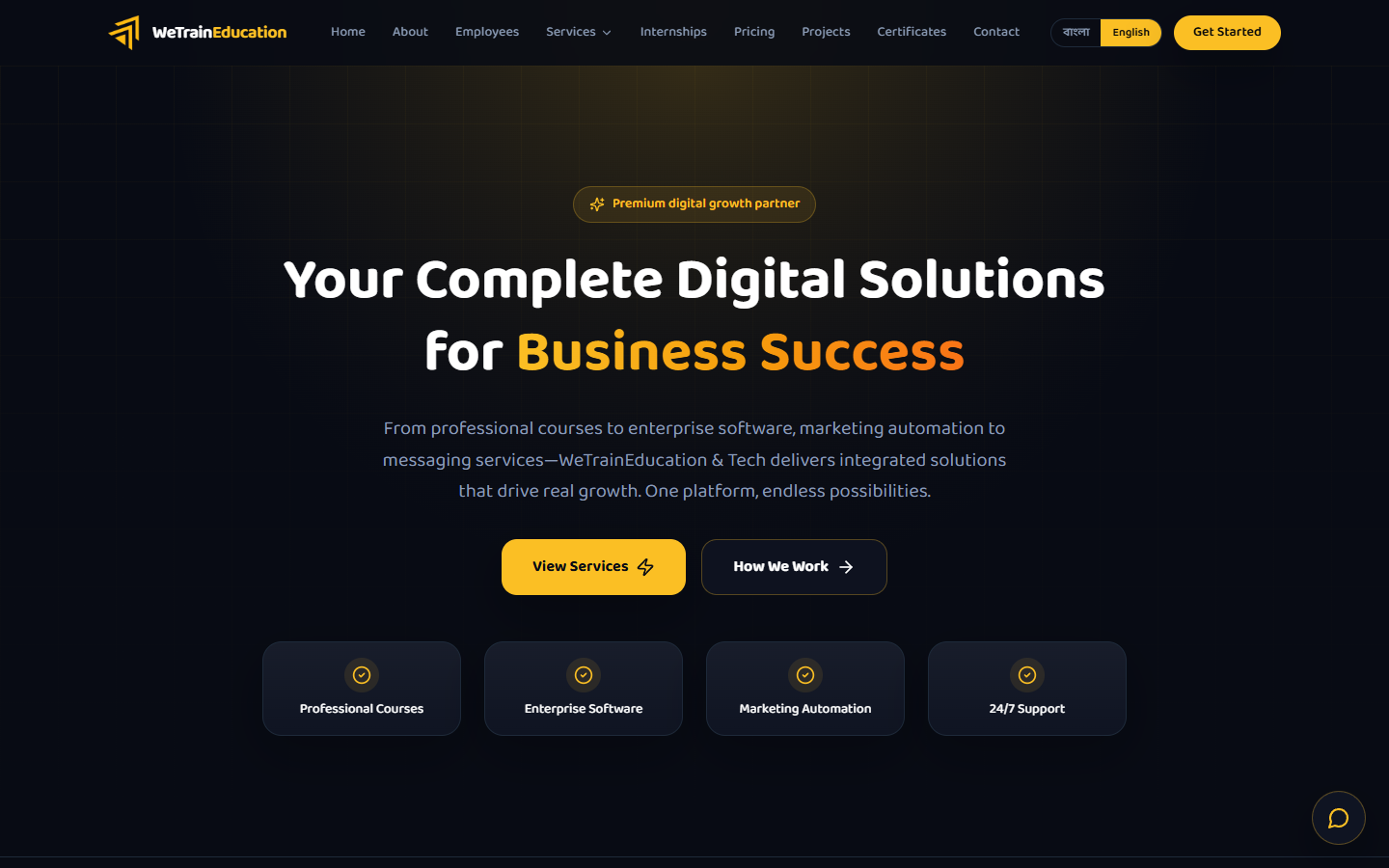
Landing. Server-rendered, English by default, Bangla switch in the header.
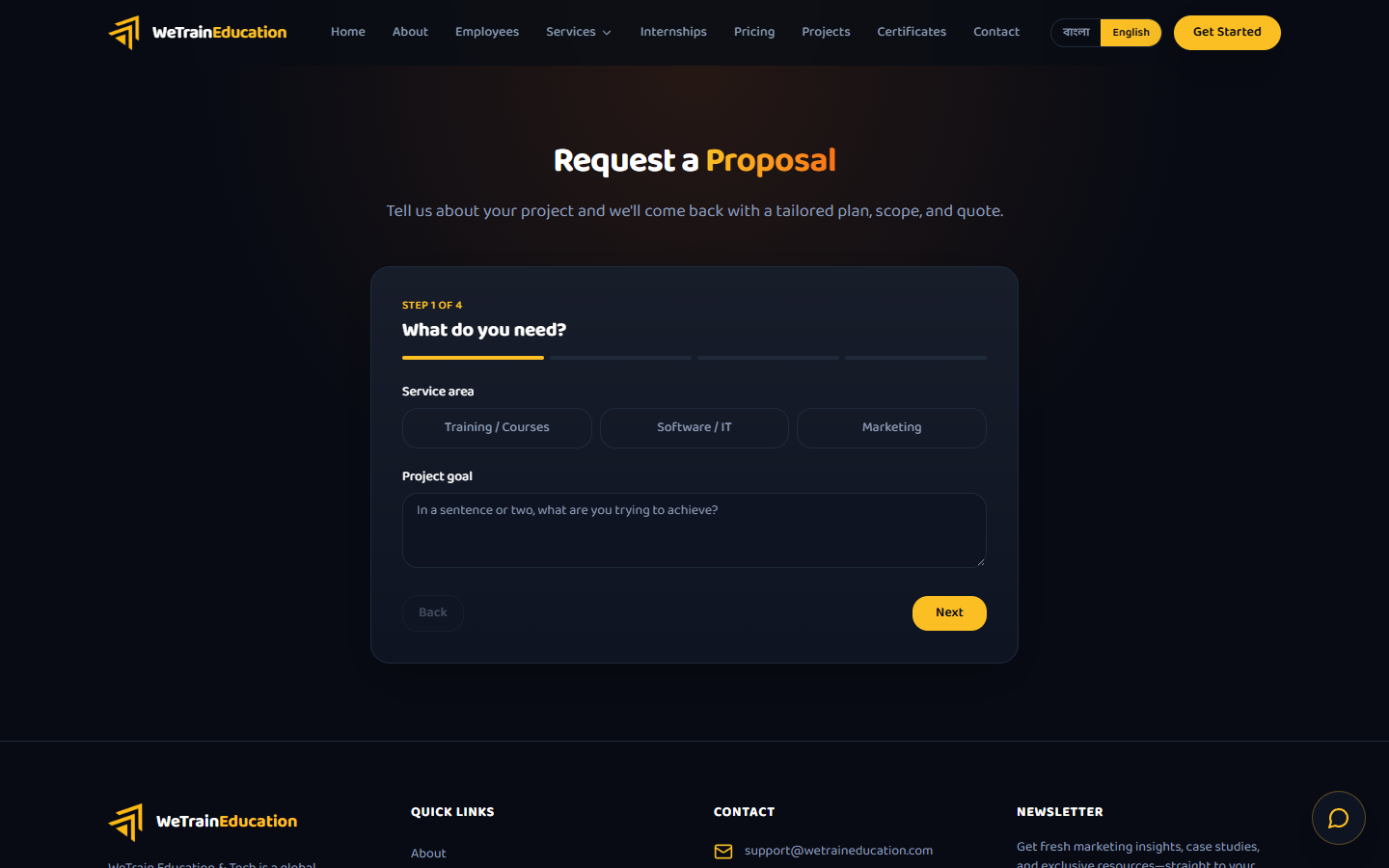
Proposal wizard. Four steps with React Hook Form and Zod, inserting with the anon key under a narrow RLS policy.
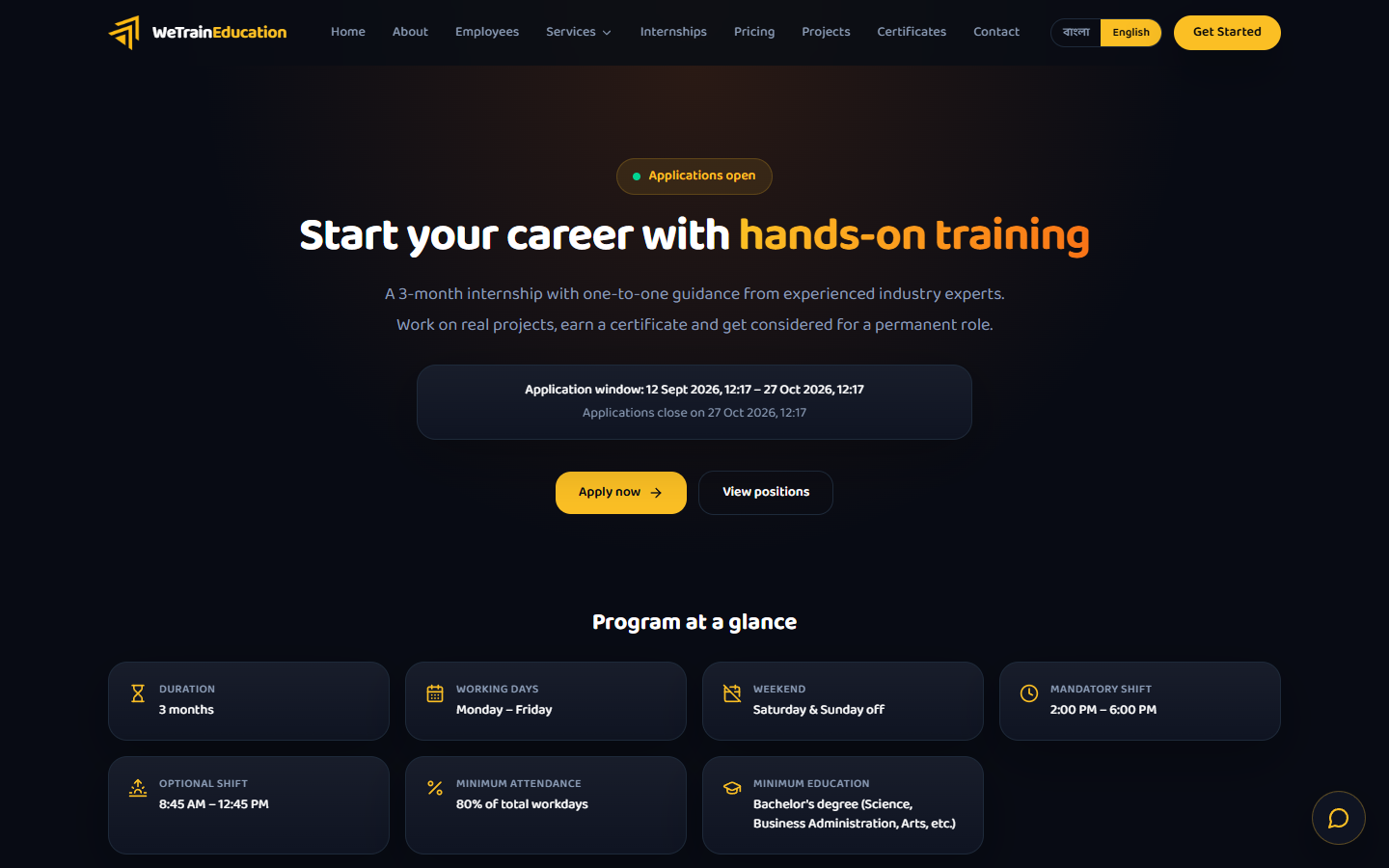
Internships. The public program page that feeds the recruitment pipeline.
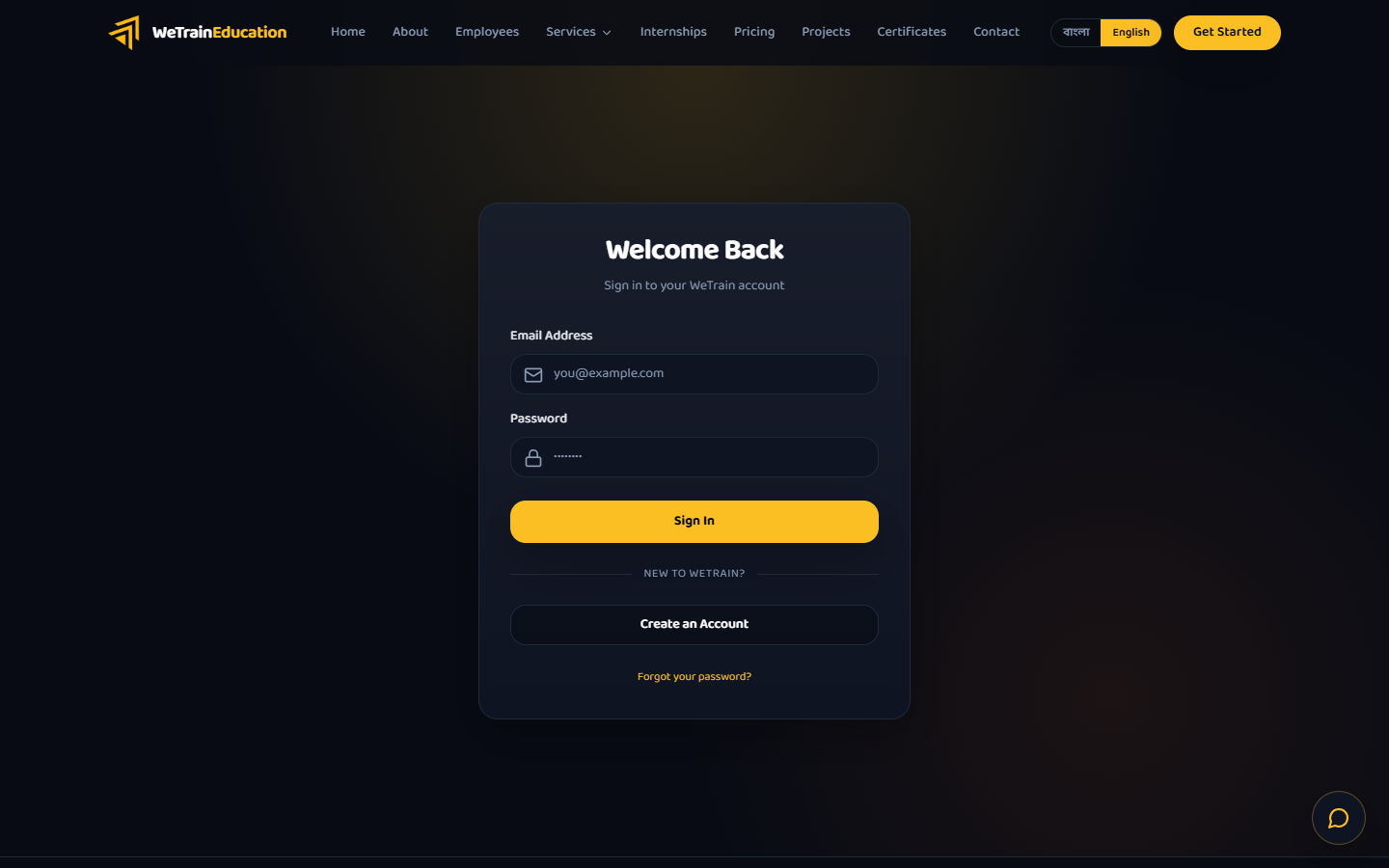
One login for every module. The proxy decides where you land.
13.2 One identity, many applications
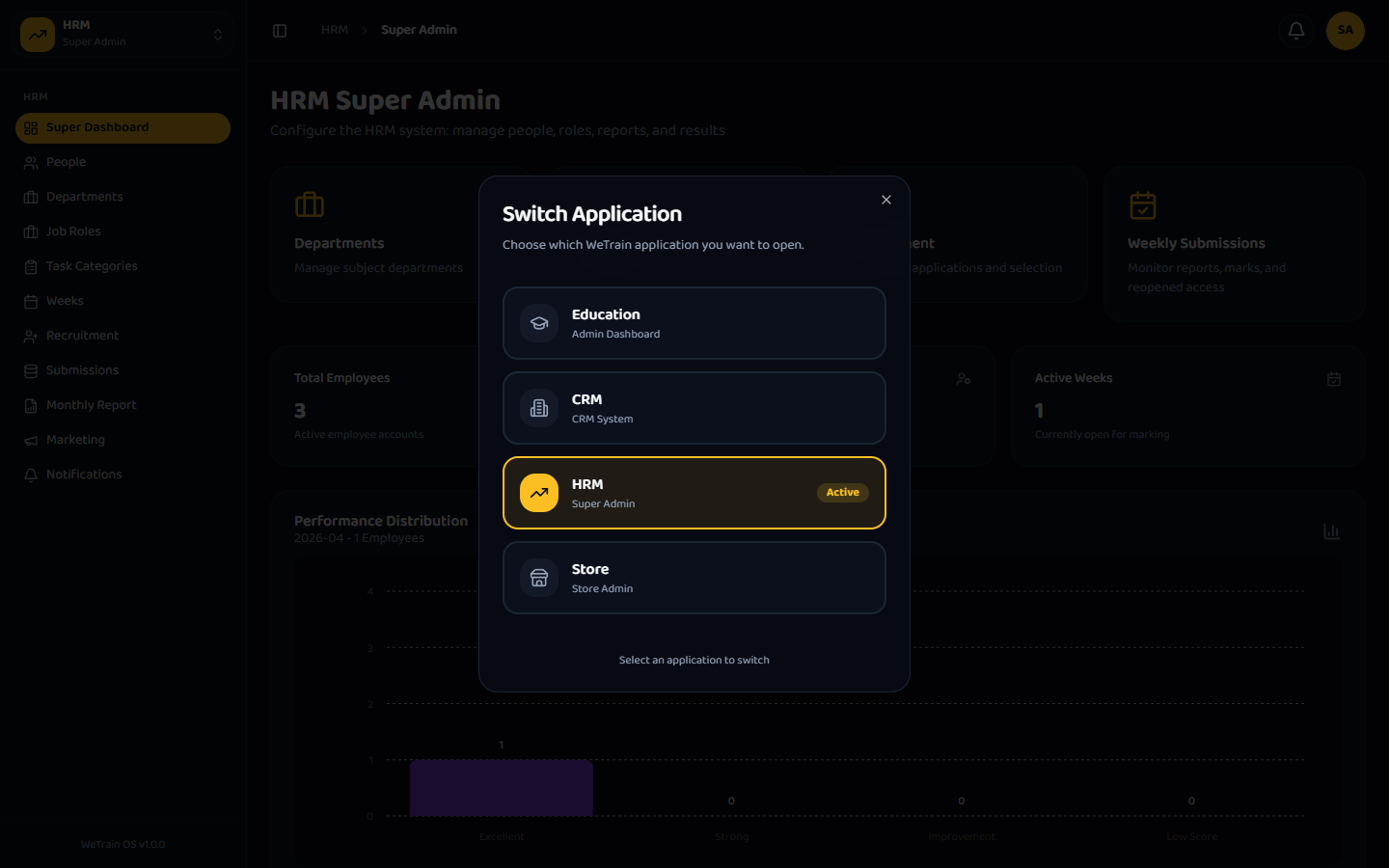
A single account with rows in several module tables sees all of them in the Switch Application dialog. The active module is highlighted, and modules a user has no row for do not appear. This is ADR-002 and ADR-003 made visible.
13.3 Education
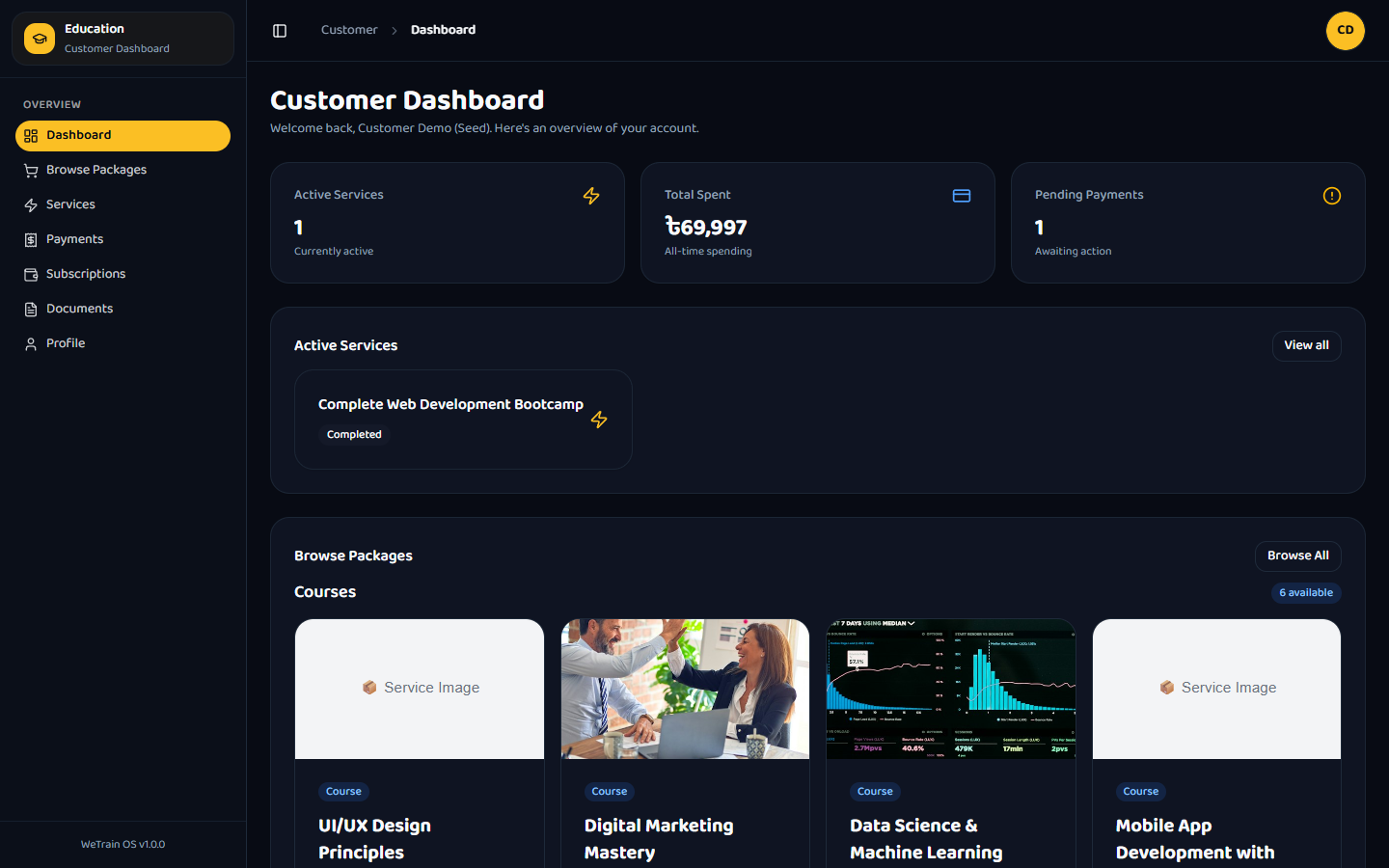
Customer dashboard. Active services, spend, pending payments and the package browser.
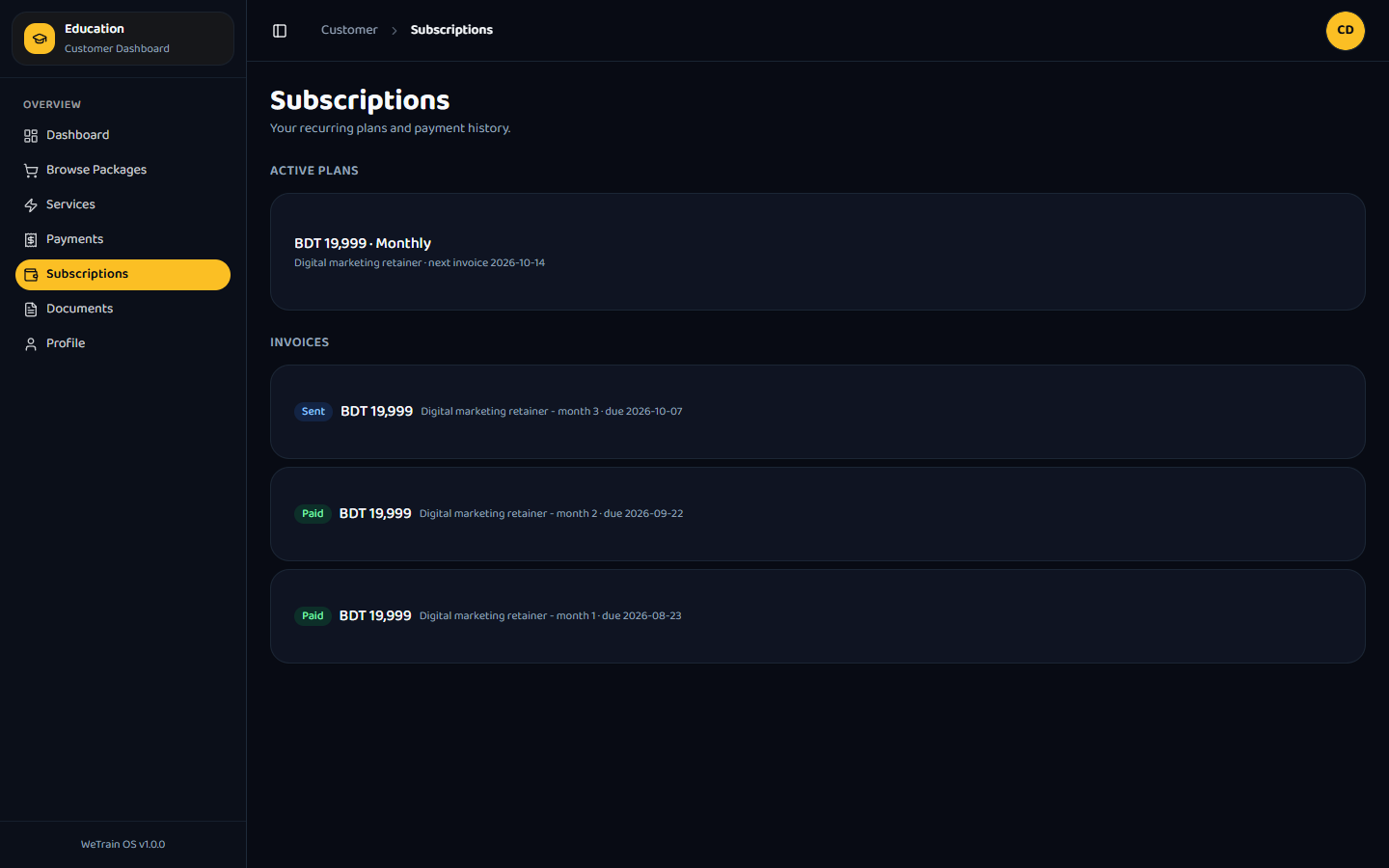
Subscriptions. The output of the daily billing cycle: paid and open invoices.
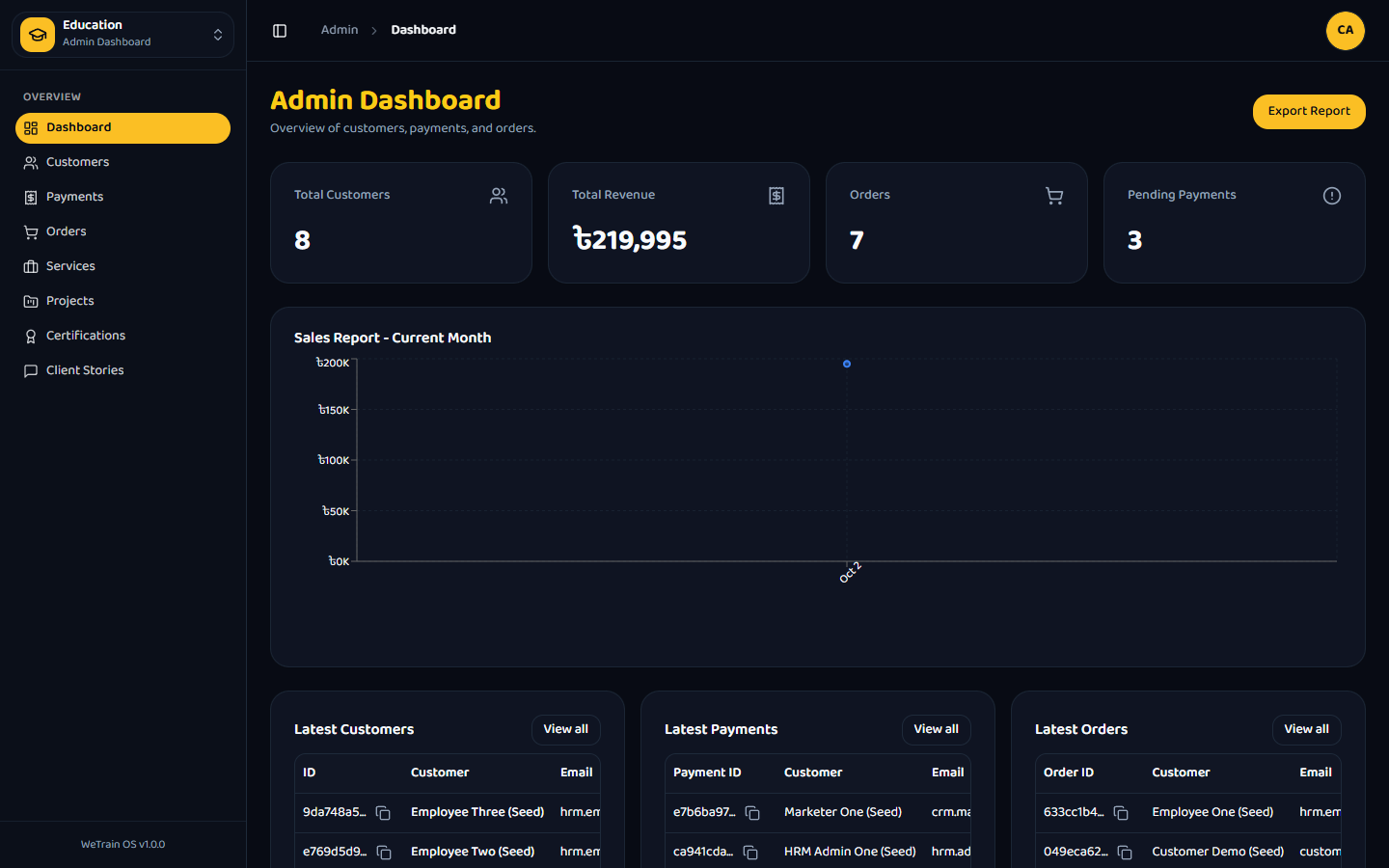
Education admin. Customers, revenue, orders and pending payments at a glance.
13.4 CRM
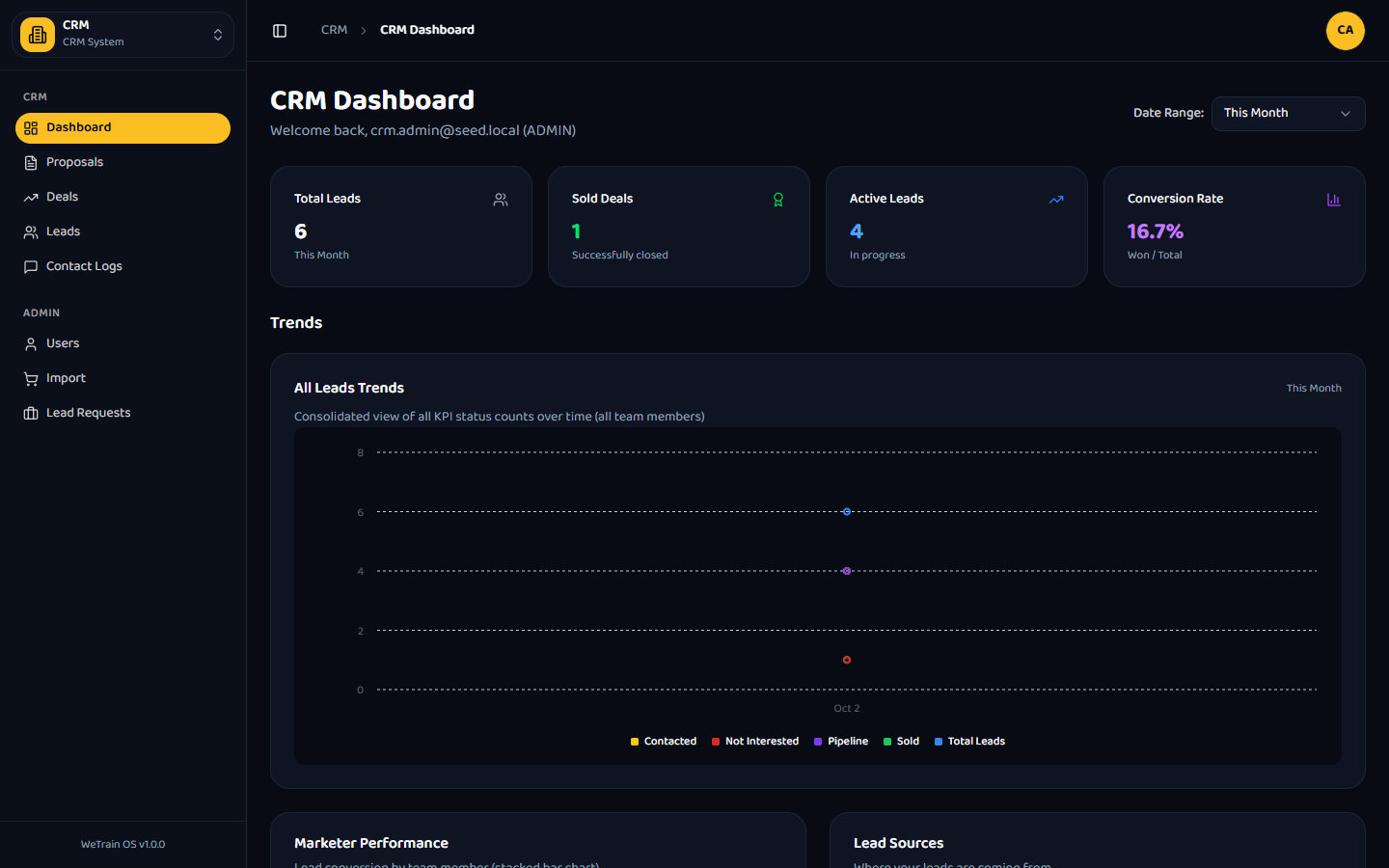
CRM dashboard. KPIs, trends, marketer performance and lead sources.
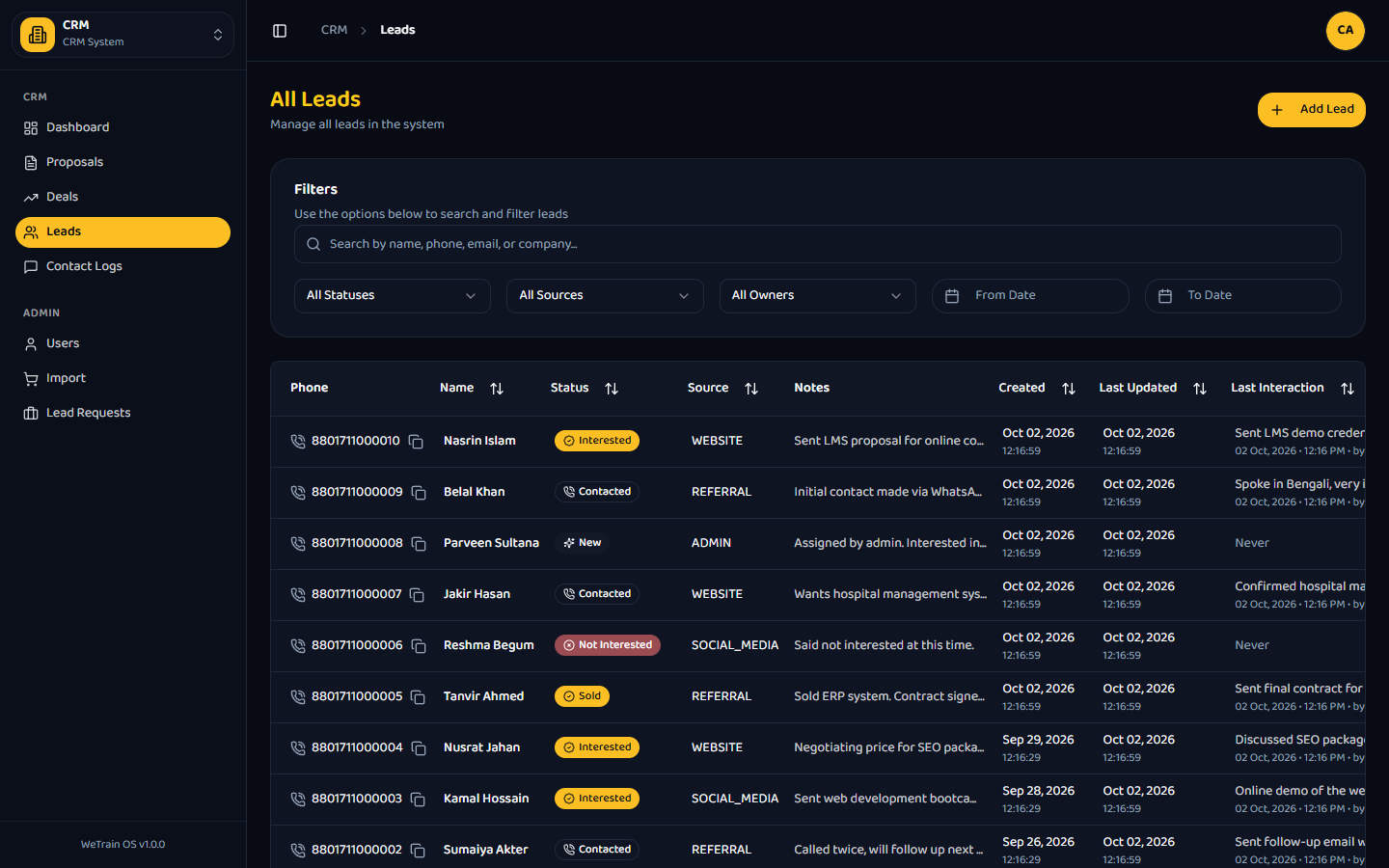
Leads. Ownership-based access: marketers work their own leads, admins see all.
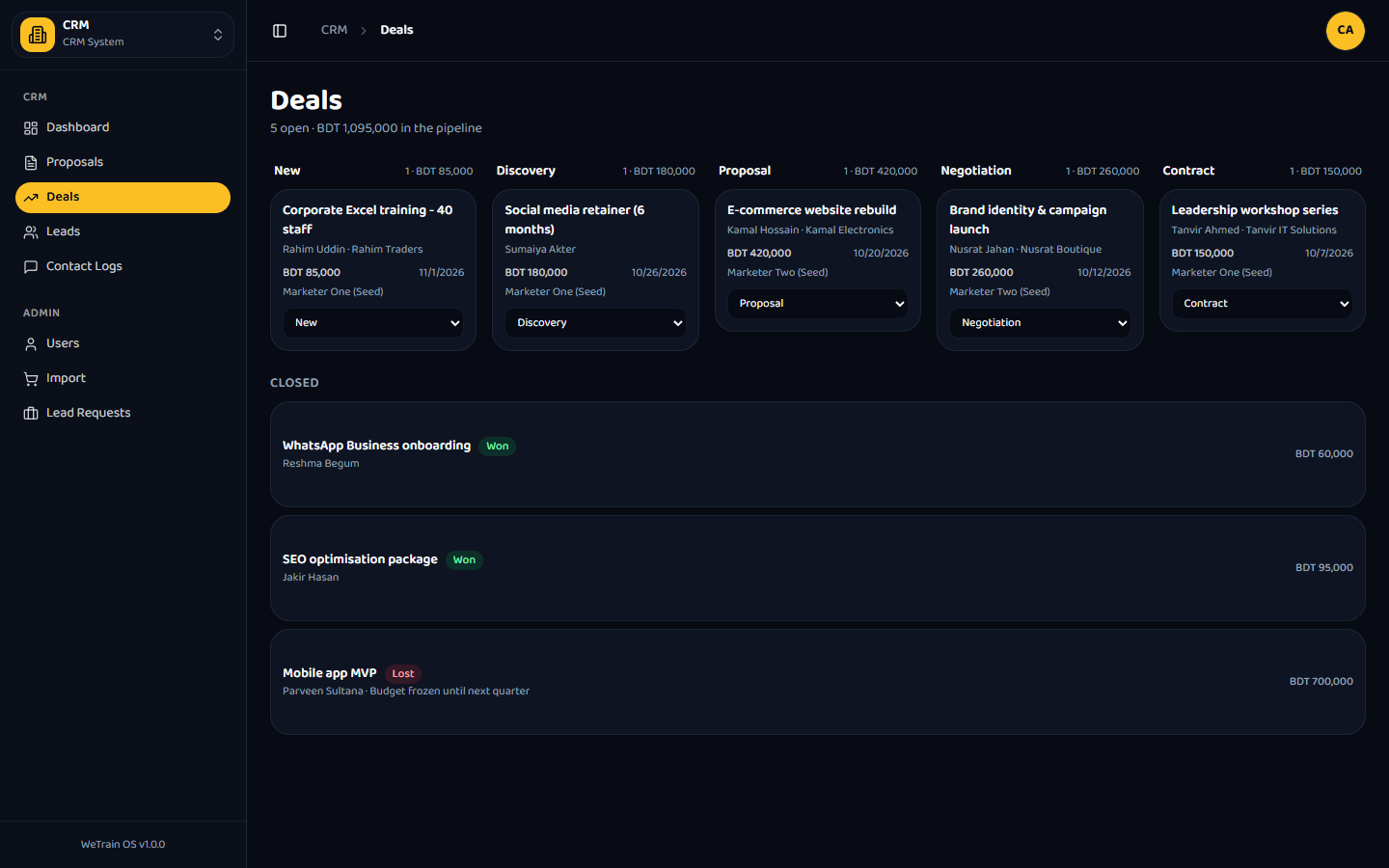
Deals pipeline. Five open stages plus closed Won and Lost, with per-stage value totals.
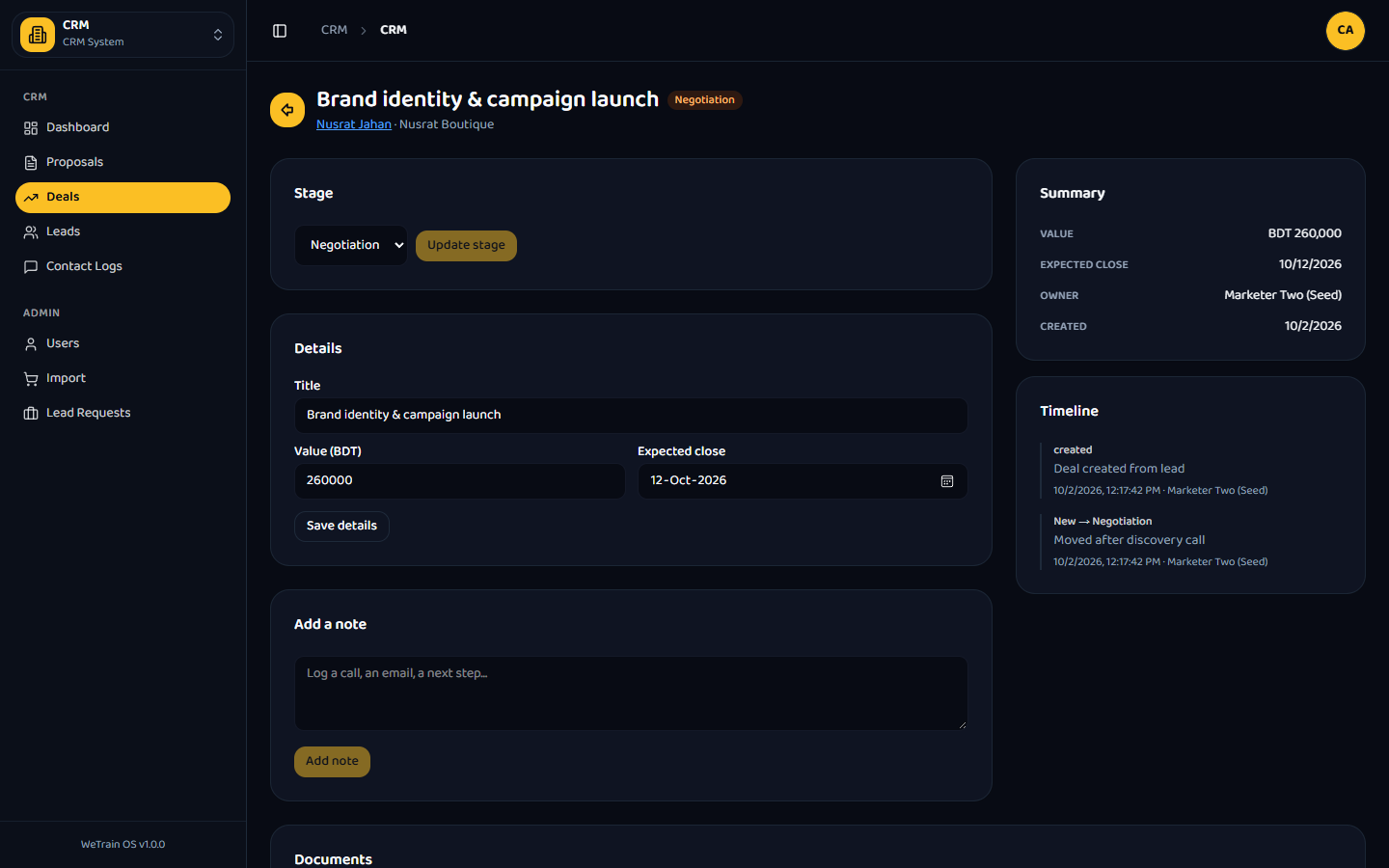
Deal detail. Stage control, notes, and an append-only timeline backed by the deal_events table.
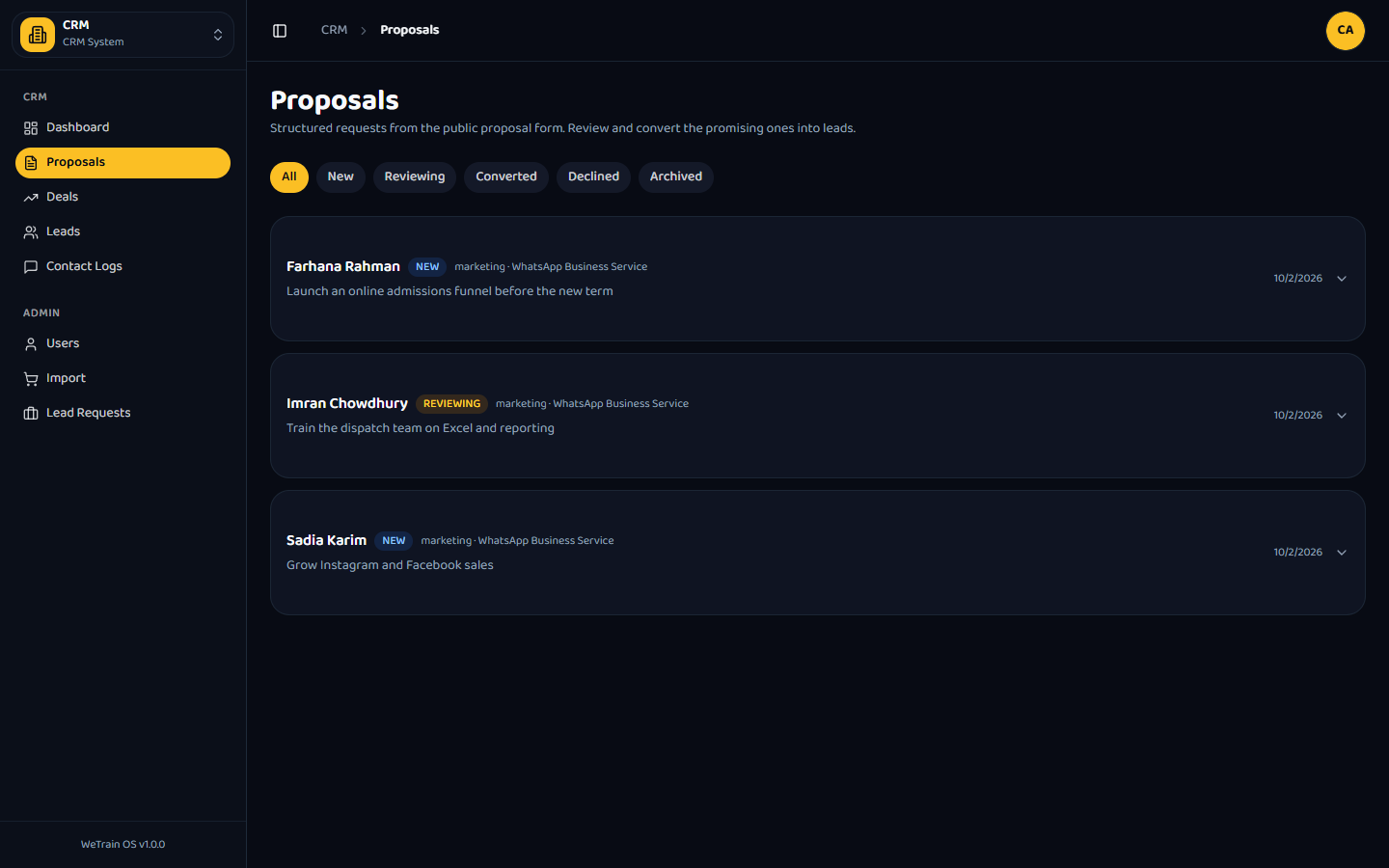
Proposal inbox. Public submissions land here for review and one-click conversion to a lead.
13.5 HRM
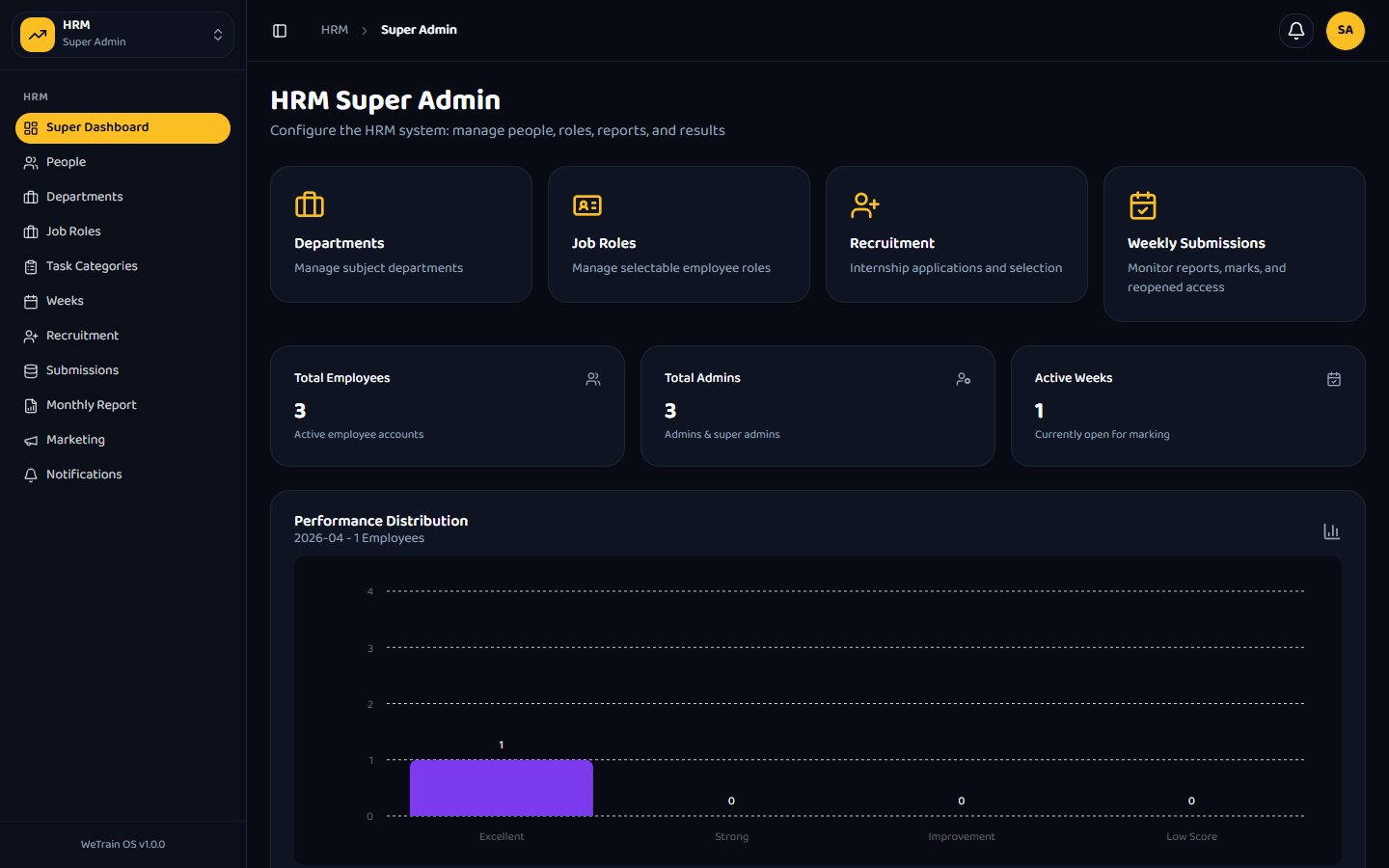
Super admin. People, departments, job roles, recruitment, weekly submissions and performance distribution.
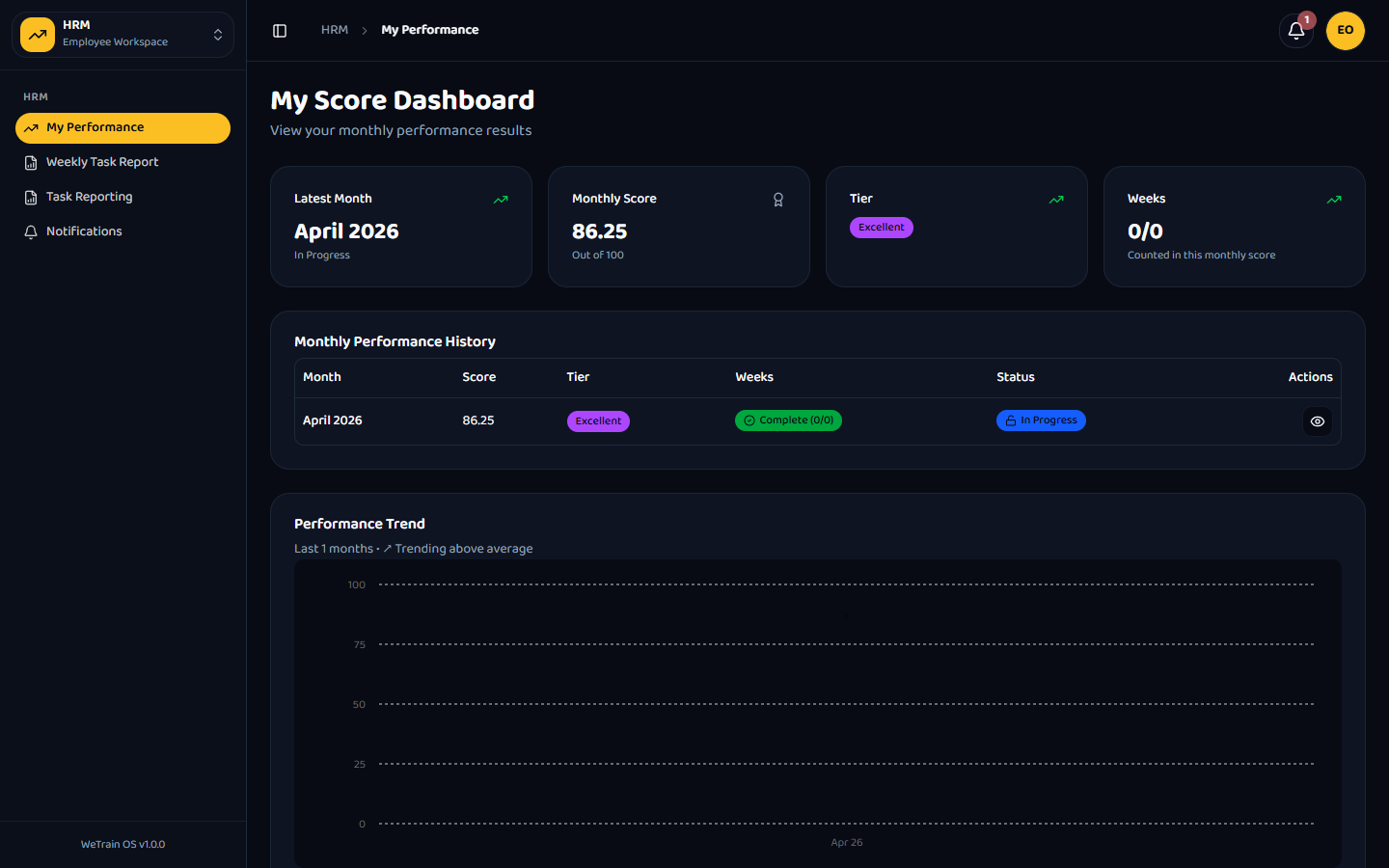
Employee view. Monthly score, tier, history and trend: the same module with a very different capability set.
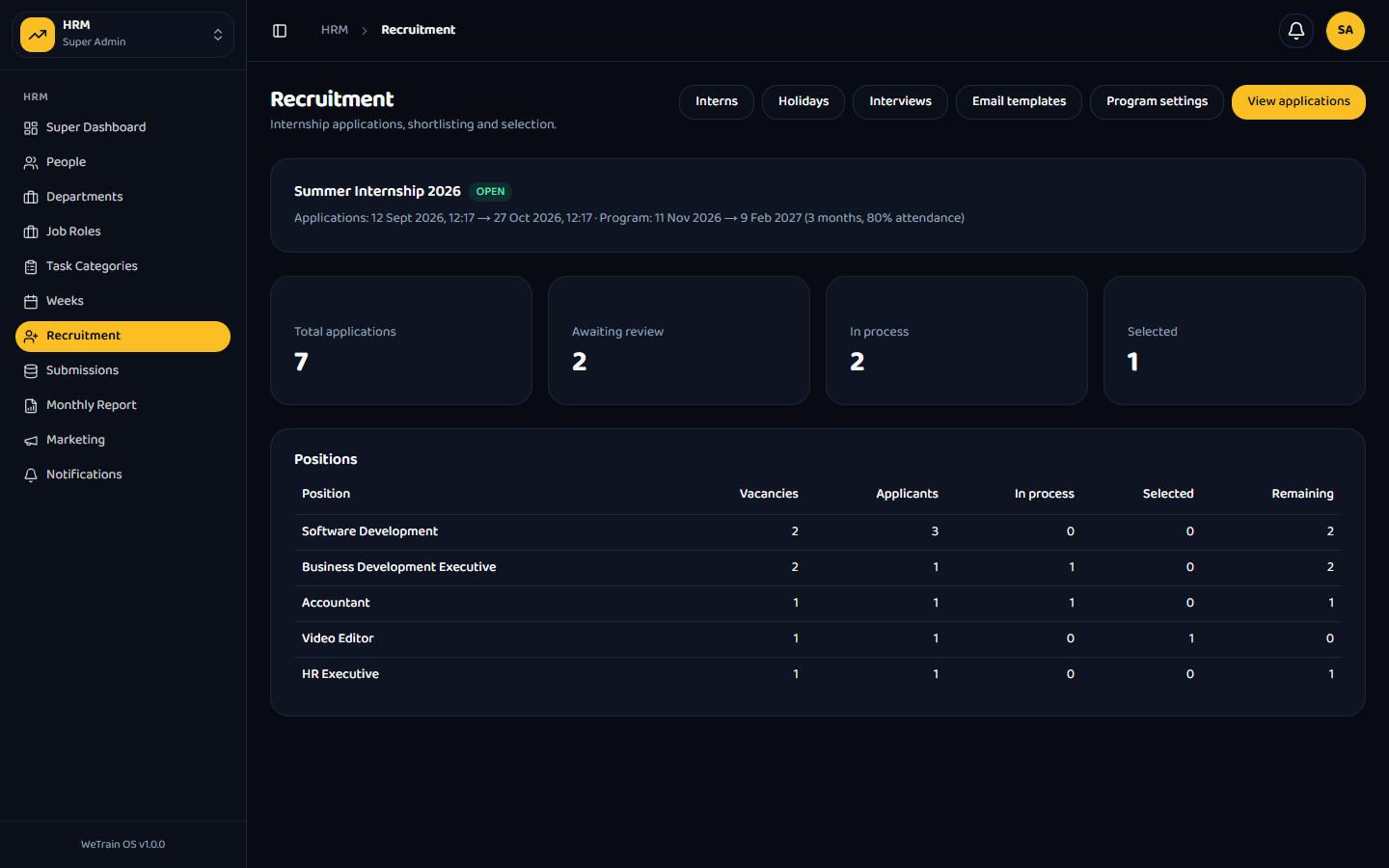
Recruitment. Program window, funnel counts and per-position vacancies.
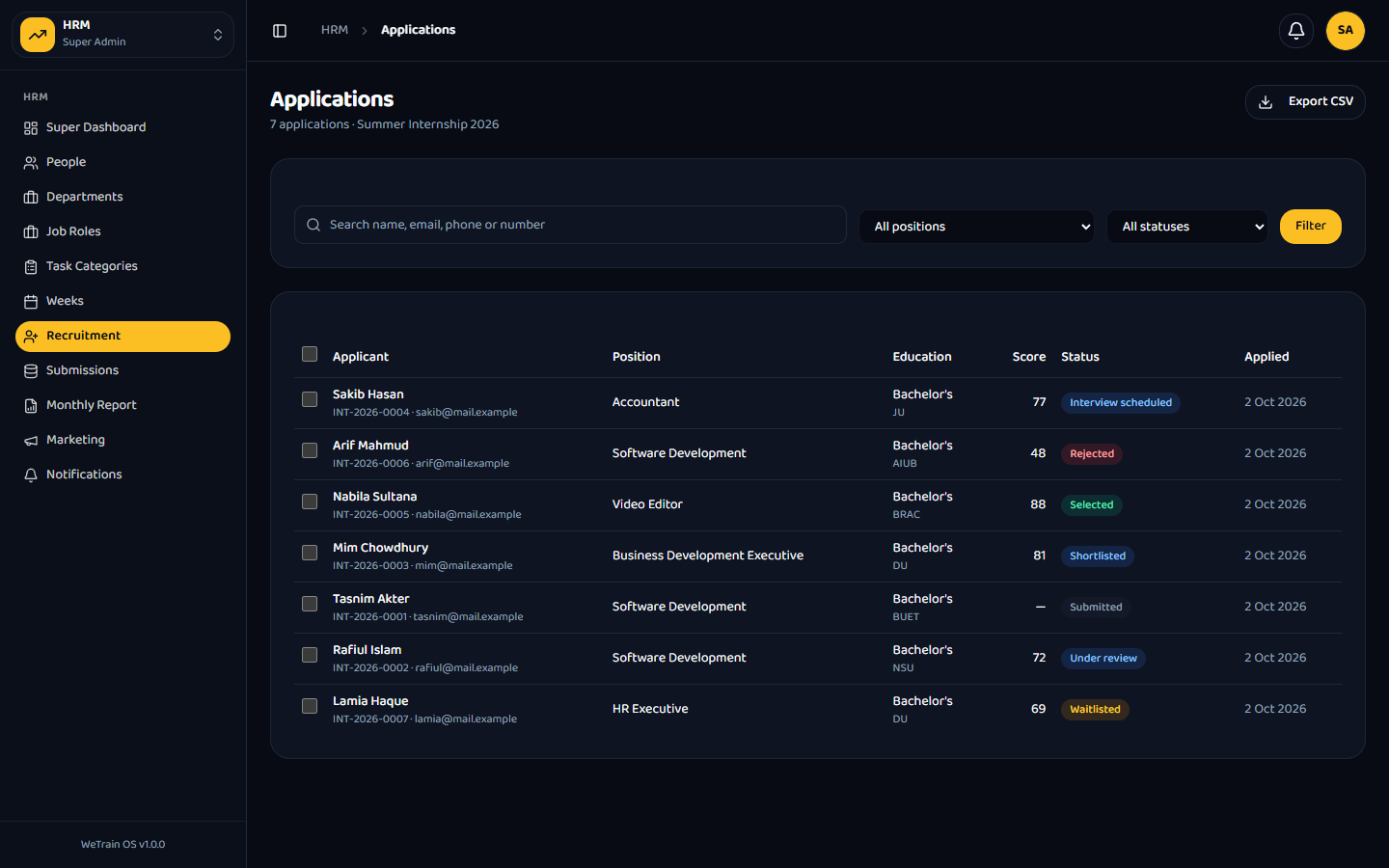
Applications. Search, filter and CSV export across all pipeline states.
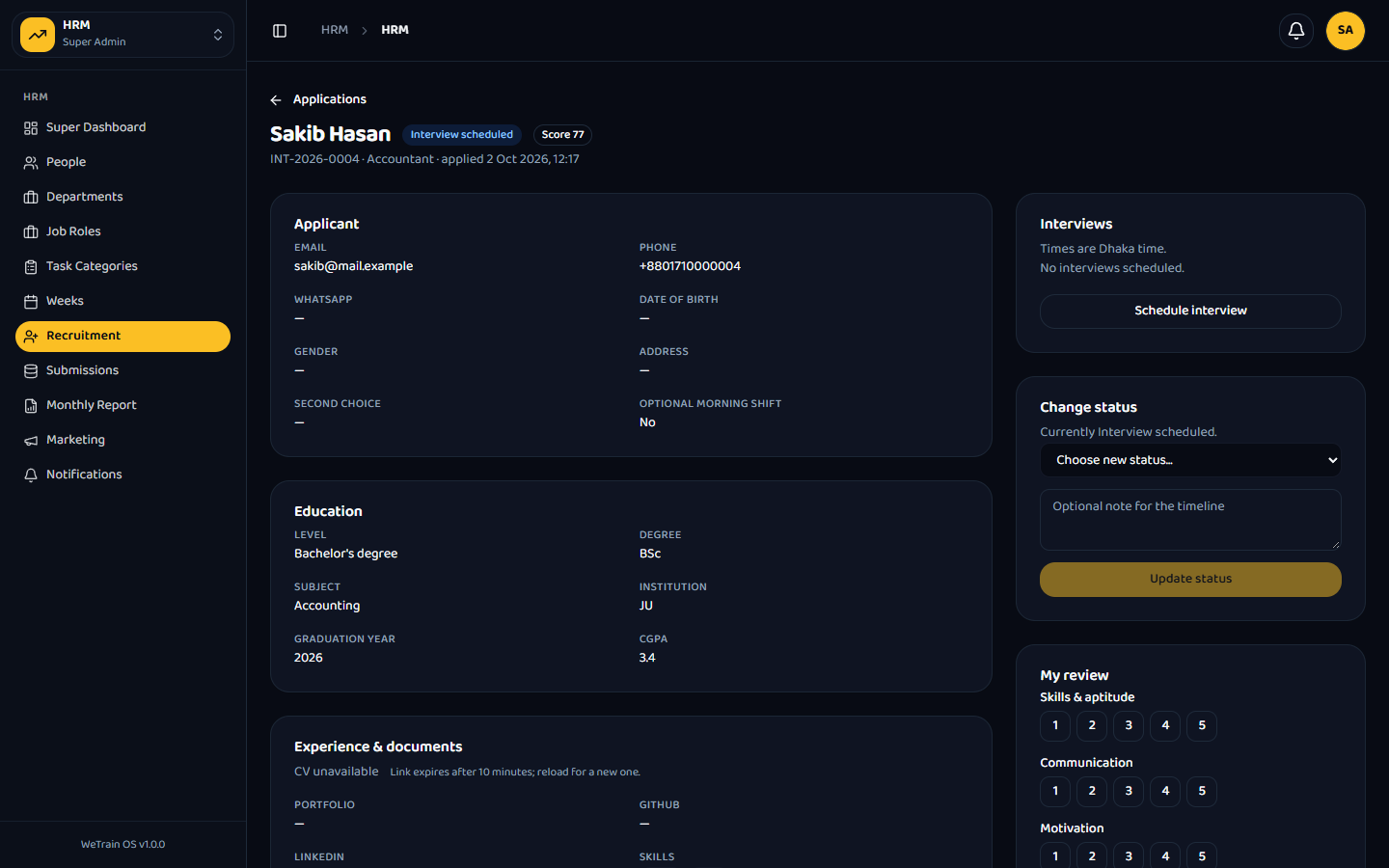
Application detail. Applicant data, interviews, status changes with timeline notes and structured reviewer scoring. The CV link is a short-lived signed URL.
13.6 Store
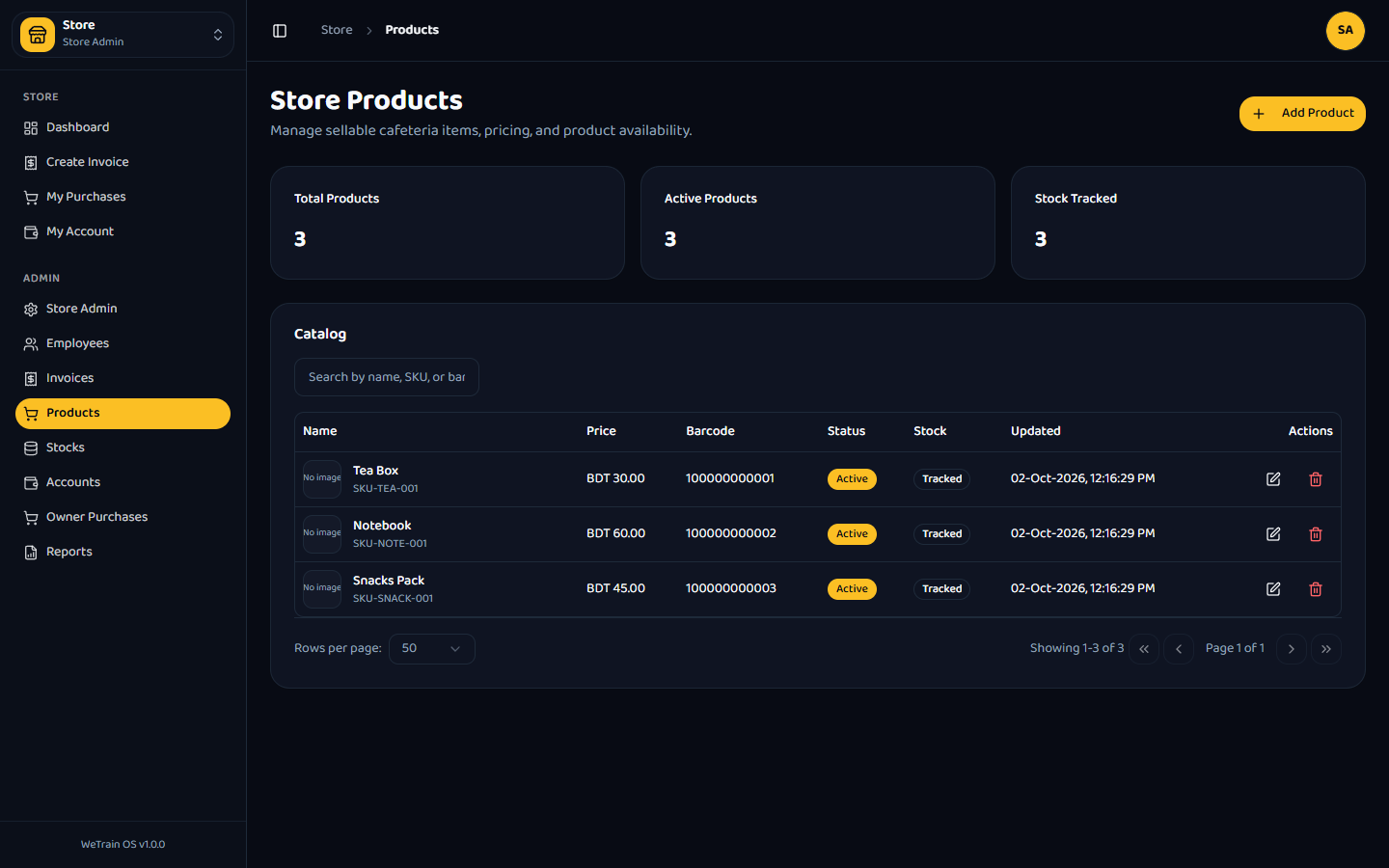
Products. Catalogue, stock tracking and pricing, gated by the product_manage permission.
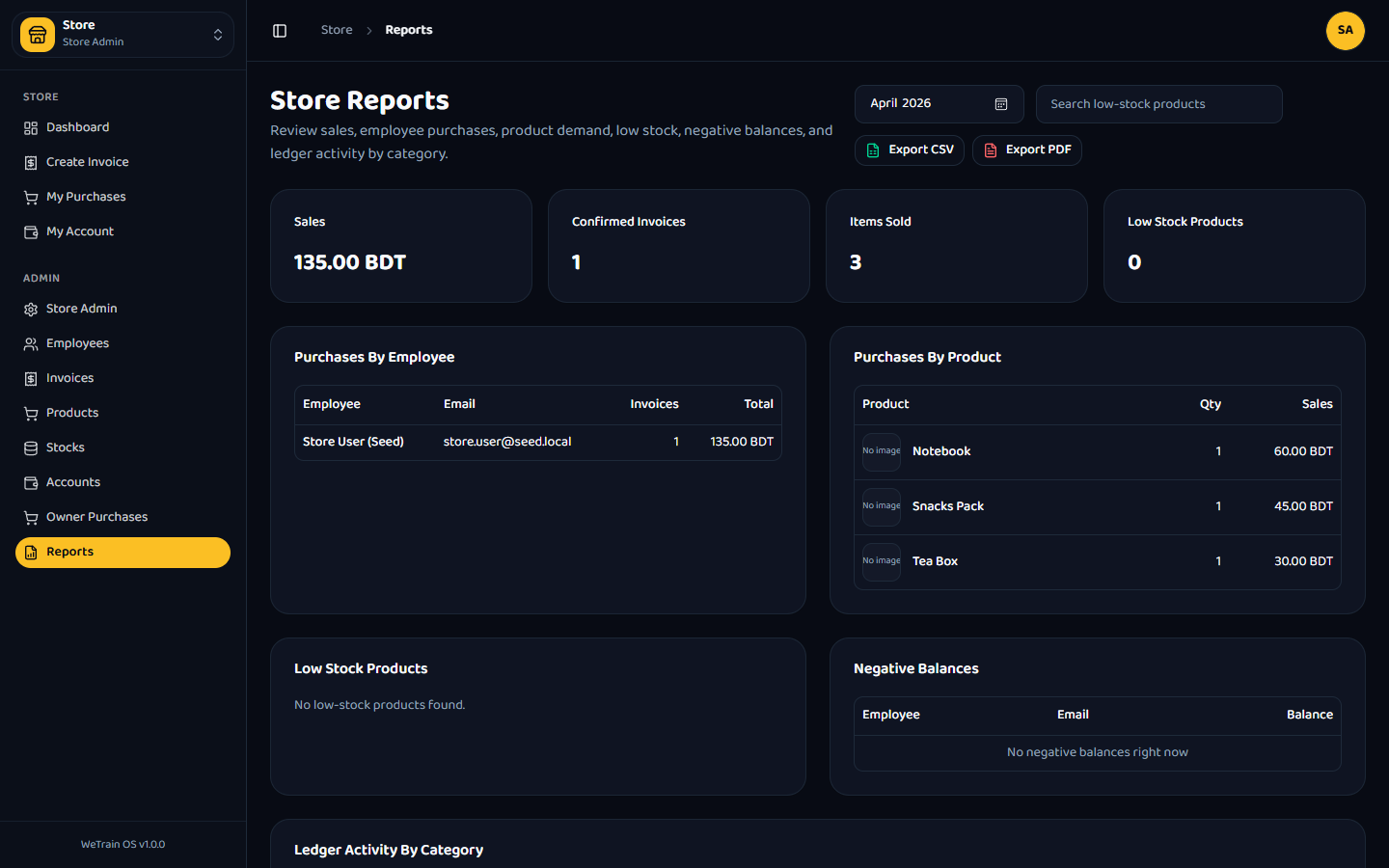
Reports. Sales by employee and product, low stock, negative balances, with CSV and PDF export.
13.7 Responsive behaviour
Mobile-first layouts: the public site on a 390px phone, and a dashboard that switches to a bottom navigation bar.
<img src="https://www.wetraineducation.com/case-study/mobile-landing-home.png" alt="Public site on a phone" width="300" /> <img src="https://www.wetraineducation.com/case-study/mobile-hrm-super.png" alt="Dashboard with bottom navigation on a phone" width="300" />
Step 15: 14. Trade-offs and honest technical debt
A case study that only lists wins is a brochure. These are the known compromises, ranked roughly by how much I would like to fix them.
Area Debt Why it exists Planned fix Authorization model app/utils/auth/crm-capabilities.tshard-codes a single "dual capability" admin UUIDA pragmatic stop-gap while CRM roles had only ADMINandMARKETERReplace with the RBAC redesign (roles, permissions, assignments) Role resolution The proxy and getCurrentUserWithRoles()each query the membership tables, the resolver's five lookups run sequentially, and the proxy does not checkhrm_users.is_active(the layout guard does)The proxy cannot share request-scoped state with server components Run lookups with Promise.all, memoise per request, and share one routing functionTest depth Tests cover domain logic, not RLS policies or end-to-end flows; CI runs only the HRM and Store suites RLS testing needs a database per run; the other suites were added later Run all suites in CI and add a Postgres-backed RLS test layer (PGlite is already a dev dependency) Seed data supabase/seed.sqluses a legacy2026-W16week key that the newer week-keyCHECKconstraint now rejects, sosupabase db resetfailsSchema evolved faster than the seed Regenerate the seed from the current schema and run it in CI Rate limiting The public internship limiter is in-memory, per instance Cheap defence-in-depth; the unique index is the real guarantee Move to a shared store (Redis / Upstash) Validation Zod is used heavily on public forms and offers, less uniformly inside internal actions Internal actions sit behind guards and were written first Introduce a shared action()wrapper that enforces auth + schemaDependencies stripeis still listed inpackage.jsonbut is not imported anywhereLeft over from an earlier gateway choice Remove it i18n scope Only the public site is translated Staff working language is English Extend namespaces module by module Docs drift Some older docs describe patterns (React Query, middleware.ts) that the code no longer usesEarly docs were aspirational Curate docs/against the code; the root rules file remains authoritativeStep 16: 15. Lessons learned
- Make the boundary the product. Naming the four modules, their route prefixes and their tables up front turned most "where does this go?" debates into lookups.
- Fail closed, in more than one place. The proxy, the layouts and RLS each assume the others might be wrong. The design survived a refactor of the proxy precisely because it was never the only guard.
- RLS recursion is easy to cause and hard to see. A
WITH CHECKthat selects from the same table made a policy recurse infinitely; the fix was a dedicated migration and a rule to test policies against intended and unintended roles. - Idempotency beats scheduling precision. Once every cron job was safe to run twice, retries, manual re-runs and overlapping schedules stopped being scary.
- Do not trust the redirect. Payment state changes only on a verified webhook; the return URL only changes what the user sees.
- Constraints are documentation that executes. A
CHECKthat a week key equals its Friday date prevented an entire class of date bugs, and also caught my own stale seed file. - Write the rules for the agent as if for a new hire.
AGENTS.md, the high-risk area list and the required reading order measurably reduced risky edits in auth and database code. - Keep what you cannot reverse small. Additive migrations, a test-then-live rollout and a refusal to touch applied migrations mean the riskiest operation in the system has a boring procedure.
Step 17: 16. Roadmap
Diagram Step 18: 17. Getting started
Prerequisites
- Node.js 20+
- Docker (for the local Supabase stack) and the Supabase CLI
Run locally against a local Supabase stack
bash# 1. install npm install # 2. start Postgres, Auth and Storage locally and apply all migrations npx supabase start # 3. configure the app (copy, then fill in the URL and keys that `supabase start` prints) cp .env.example .env.local # 4. seed test users and sample data (never run against production) npm run seed:all # 5. run the app npm run devOpen
http://localhost:3000. Seed scripts create test identities such ascrm.admin@seed.localandhrm.super@seed.local; seescripts/seed-*.mjsfor the full list and the shared test password.Note. The checked-in
supabase/seed.sqlis currently out of date with the newest migrations (see debt table). Ifsupabase startfails while seeding, set[db.seed] enabled = falseinsupabase/config.toml, start the stack, then use theseed:*scripts above.Scripts
Command What it does npm run devStart the Next.js dev server npm run build/startProduction build and server npm run lintESLint npm run format:checkPrettier check (used in CI) npm run test:allAll 88 tests npm run seed:allSeed public content, CRM and HRM test data npm run db:cleanReset seeded data npm run migrate:testApply migrations to the test project npm run migrate:liveApply migrations to the live project (after verifying on test) AI-assisted development
AGENTS.mdis the primary instruction file for agents;CLAUDE.mdimports it..mcp.json/.vscode/mcp.jsonconfigure the Next.js DevTools MCP and the Supabase MCP. Use them against local or non-production environments only.- Repo-local guides live in
skills/.
Step 19: 18. Repository map
textapp/ ├── (landing)/ # public marketing, proposals, internships, verification ├── dashboard/ │ ├── customer/ admin/ # Education │ ├── crm/ # CRM (_actions, _components, _constants, _types) │ ├── hrm/ # HRM (super | admin | employee, recruitment, internship) │ └── store/ # Store (_actions, _components, _lib) ├── api/ # webhooks, cron, uploads, signed downloads ├── auth/ # unified callback, invite, magic link, email change ├── actions/ # public server actions (proposal, internship, locale) └── utils/ ├── auth/ # roles.ts, require.ts, hrm-access.ts, crm-capabilities.ts └── supabase/ # client, server, admin, middleware, env components/ # ui/ (shadcn), shared/, hrm/, skeletons/ lib/ # billing/, hrm/, internships/, validations/ i18n/ messages/ # next-intl config and en / bn catalogues supabase/migrations/ # 104 forward-only migrations scripts/ # seed, migrate, verify, clean tests/ # crm, education, hrm, store, landing, ui docs/ skills/ AGENTS.md # durable references and agent rules proxy.ts # Next.js 16 proxy (session refresh + coarse gate) vercel.json # cron schedules public/case-study/ # screenshots and diagrams used in this READMEFurther reading
AGENTS.md: primary contributor and agent rulesdocs/README.md: map of the durable documentation setdocs/ARCHITECTURE_DECISION_USERS_PROFILES.md: the original long-form ADR for ADR-002docs/CRITICAL_SYSTEMS.md: systems that must not regressdocs/HRM_CRON.md: scheduled HRM logicdocs/DATABASE_RULES.mdanddocs/DATABASE_MIGRATION_SAFETY.md: database safety
Built with Next.js, Supabase and a lot of care about who is allowed to see what.
Step 20: Features
- Single sign-on across Education, CRM, HRM and Store from one Supabase identity
- Priority-based routing and a module switcher for users with multiple roles
- Public marketing site with English and Bangla language switch
- Four-step proposal wizard that feeds the CRM inbox
- Online checkout with SMS Pay BD and signature-verified webhooks
- Customer portal with payments, subscriptions, invoices and shared documents
- Education admin dashboard for customers, orders, revenue and payments
- CRM lead management with ownership-based access
- CRM seven-stage deal pipeline with an append-only activity timeline
- Versioned contracts and documents in private storage with signed download links
- Recurring billing through daily scheduled payment links, reminders and overdue tracking
- HRM weekly task reporting, 0-100 marking and monthly performance tiers
- Automated Friday cron jobs for weekly reports, reminders and result computation
- Internship recruitment with applications, reviews, interviews, offers and onboarding
- Public applicant tracking page, offer accept/decline page and certificate verification
- Intern attendance, no-show handling, attendance warnings, completion and certificates
- Internal Store with ledger-based balances, stock management and granular admin permissions
- Store reports with CSV and PDF export
- Layered security: proxy session gate, layout guards, server action checks and Postgres RLS
- Idempotent, secret-protected cron jobs and logged email delivery with retry
- Dark-first responsive UI with mobile bottom navigation and skeleton loading states
- Forward-only database migrations with a test-then-live rollout
- CI pipeline with Prettier, ESLint, unit tests and production build
Keep exploring
View all projects Related projects
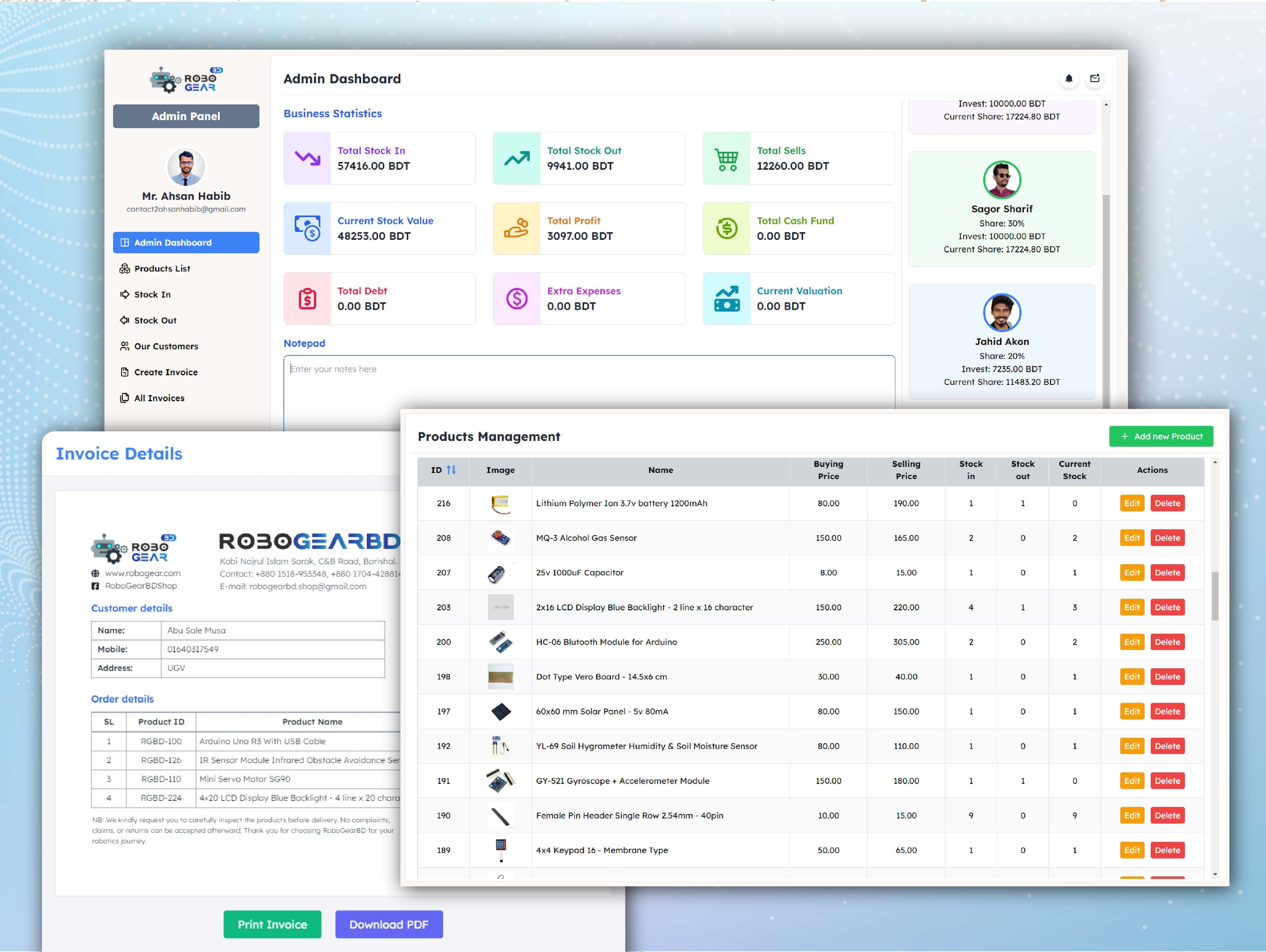
Full Stack · E-commerce
Robogear Admin
E-commerce Admin Panel
React · Tailwind · Node.js · Express
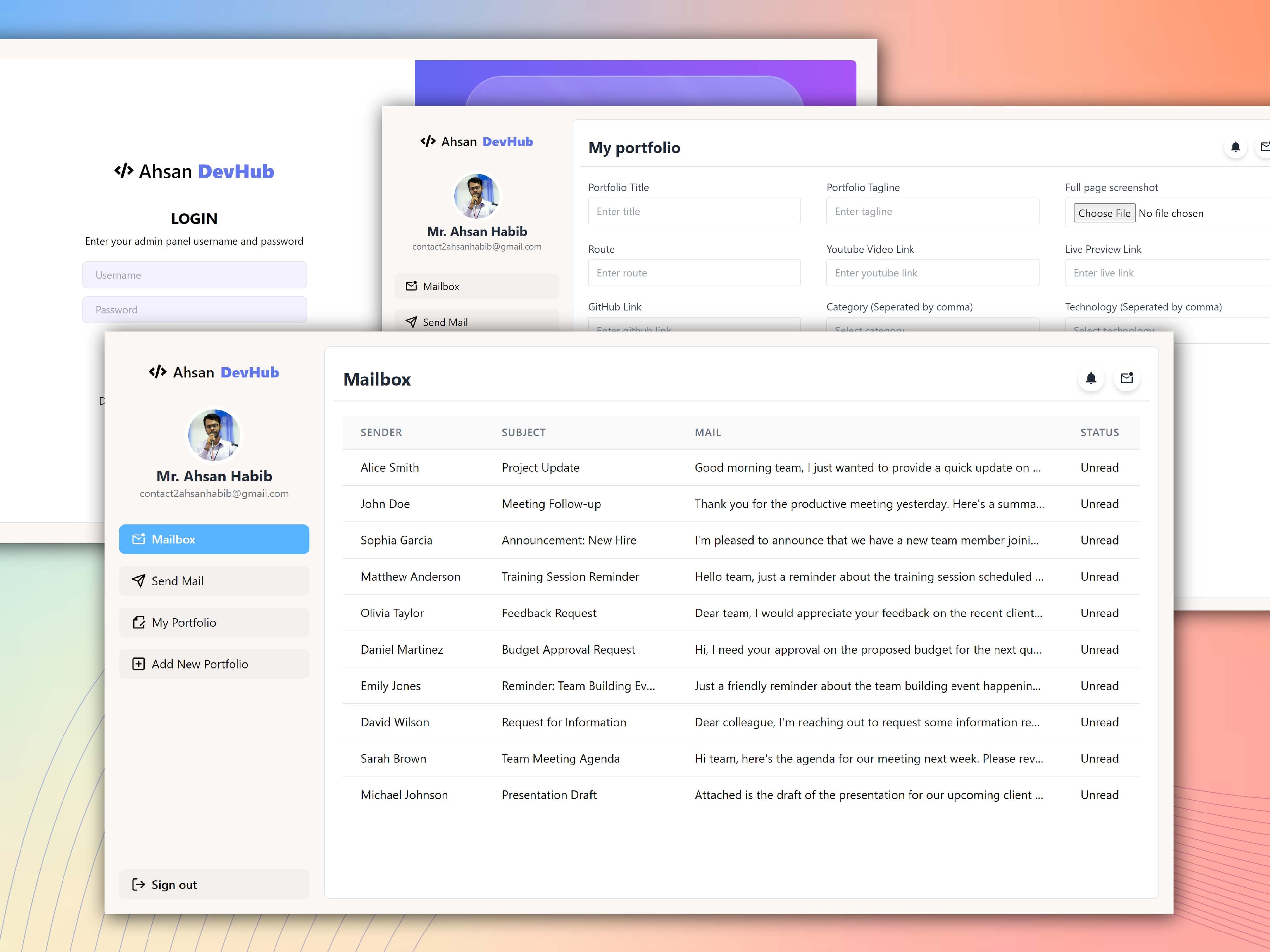
Full Stack · Dashboard
AhsanDevHub Admin
Portfolio Admin Panel
React · Tailwind · Node.js · Express
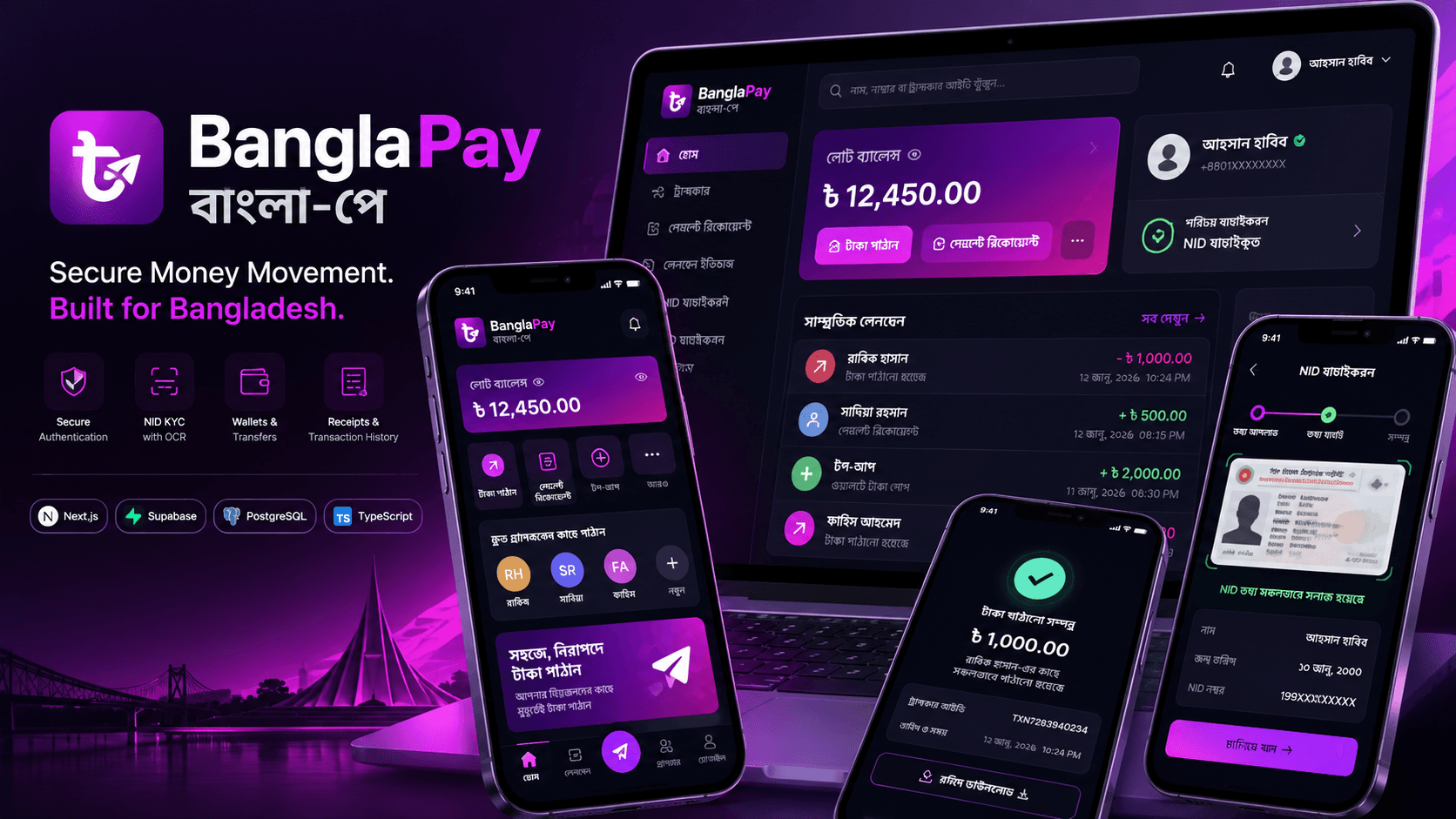
Full Stack · Fintech
BanglaPay
A secure Bangla-first mobile financial service simulation built with an auditable double-entry ledger
Next.js 16 · React 19 · TypeScript · Tailwind CSS v4
 Newsletter
Stay in the Loop
Occasional emails about new projects, blog posts, and what I'm building - no spam.